Showing posts with label Journals. Show all posts

Tuesday, 9/9 - More Anglo-Saxon Background

  • 3PO 
  • GUM: Begin writing down the Lit Terms posted on the right hand column for Unit 2: The Anglo-Saxon Era
  • Anglo-Saxon Intro - HW check
  • Begin Beowulf?

HW: 
  1. If there is a particular college that interests you, please bring a snapshot of their personal statement prompt with you to class on block day.


Wednesday, 2/6 - "It is a truth universally acknowledged that . . .

http://upload.wikimedia.org/wikipedia/commons/thumb/1/17/PrideAndPrejudiceTitlePage.jpg/180px-PrideAndPrejudiceTitlePage.jpg
You're not worthy! ; )
. . . a high school student in possession of a week off of school must be in want of a novel."
  • P&P
  • Your Modest Proposals
  • Now, you prideful and prejudiced male thunder puppies, get yourself a copy of Jane Austen's Pride and Prejudice and prepare to die a whimpering juvenile and rise a robust man!
    • We are going to try out an app called Subtext, the latest in interactive e-books. If you don't already have it, please get it. You must have the latest OS to do this, as I'm told. If you cannot, go to the ARC sometime over the next couple of days because I want to begin using it.
    • Once you have the app, you'll need to log in using either your Facebook account or your gmail account, the one that the school gave you. If you don't know it, then look it up or go to Student Services.
    • To join Reno's group, called English 400, you'll need the following code: IYQICHGW. 
    • Now select Jane Austen's Pride and Prejudice from the English 400 bookshelf. 
  • For the time being, please read the first three chapters of P&P and do the following journal:
J13 - First Impressions
Having just met our author and her characters, record your first impressions about the following:
    1. Mr. and Mrs. Bennet - What is your view of them based on just three chapters? Please cite at least one quote to support your view of each.
    2. Testing: please fill out the form at the end of this link
HW: 
  1. Read the first three chapters of P&P (Pride & Prejudice)
  2. J13  

Tuesday, 2/4 - You fight like a girl

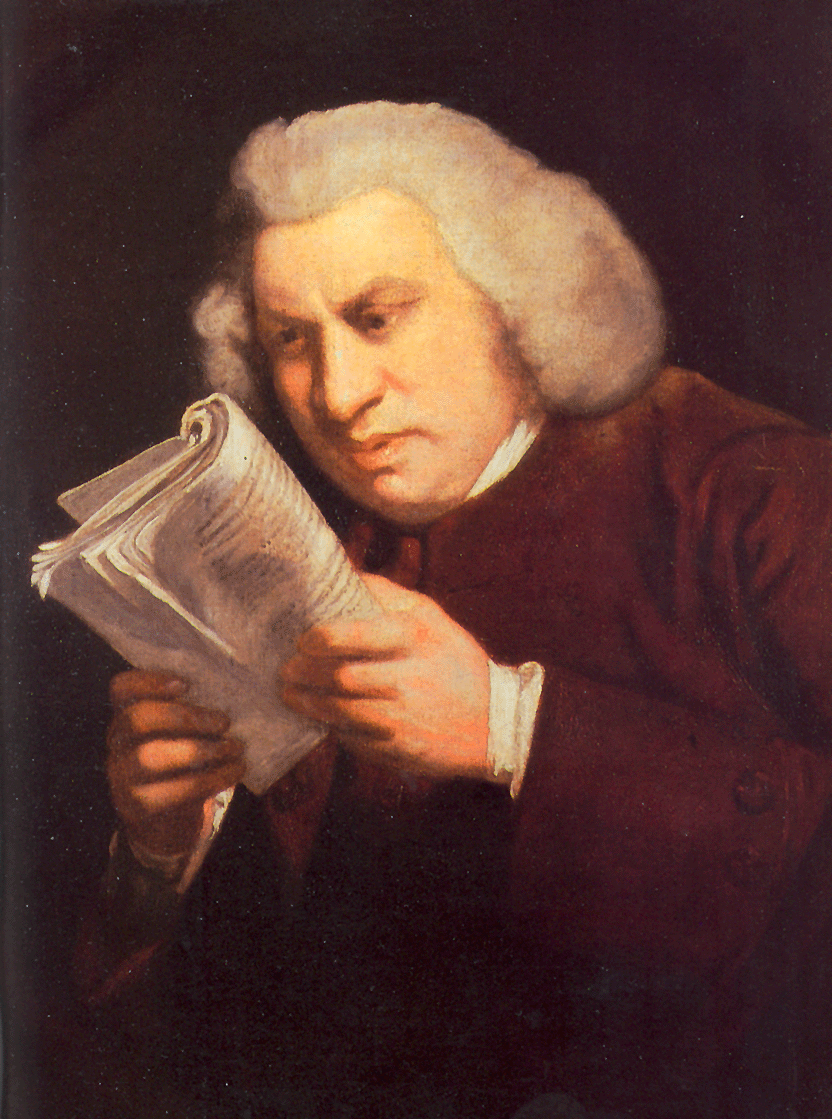
Samuel Johnson (1709-1784)
  • P&P
  • GUM: Samuel Johnson’s views of humanity were conservative and traditional. He criticizes the popular belief in progress the belief that things are getting better and better and the assumption that men and women are naturally good that is, the notion that if society is reformed, people will automatically do what is right. 
  • Finish presentations
  • Copy down nails into notes.
  • Please copy down the following Lit Terms and their definitions:
    • Premise - an assertion that supports a conclusion
    • Conclusion - the main assertion that follows from a premise or premises
    • Counterargument - an opposing viewpoint or premise
    • Refutation (to refute) - a discrediting of a counterargument
    • Concession (to concede) - an acknowledgment of the merit of a counterargument
  • J12 - Logos, Ethos, and Pathos in the Service of the Military 
  1. Identify Johnson's conclusion (his main assertion) and at least one premise that supports his conclusion.
  2. Identify at least one use of logos, ethos, and pathos (three total) in Johnson's article, explaining why each example qualifies as the particular type of appeal.
  3. Identify at least one use of logos, ethos, and pathos (three total) in Smith's article, explaining why each example qualifies as the particular type of appeal.  
  4. Does Smith address any counterarguments to his position? If so, does he concede or refute any of them? 
  5. What is the moral basis of Smith's whole argument (provide a quote that you believe sums it up)?
  6. Can you think of a counterargument to challenge his assumption? 
  7. How would you describe the tone--the author's attitude--of each essay? (Select two adjectives to describe each one)?
  8. Of  logos, ethos, or pathos, which one do you think appeals most to our culture at large today and why?
HW: (due block)
  1. Sonnet recitation
  2. Finish J12

Monday, 11/18 - I will enter into his courts . . . wearing black

    Hamlet, anyone? Anyone, Hamlet? Hamlet. Hamlet. Omelet.
  • P&P
  • Sight Words Quiz 1 - When you finish, please begin J8 below.
  • "Hamlet . . . stands alone supreme in varied excellence. Ambition, murder, resistless fate, filial love, the love of woman, revenge, the power of conscience, paternal solicitude, infinite jest: what a volume is this!" - Henry Coppee (President of Lehigh University - 1873)

HW:  J8 - Hamlet, Act 1 (due Wednesday)

Read Leithart (pgs. 120-129) and answer the following questions (Remember that Leithart is the PDF posted on Focus that you used to do J6):
  1. What dramatic and thematic purposes does Fortinbras, the young prince of Norway, serve? 
  2. Contrast the late King Hamlet (the ghost) with Claudius (his brother and present King of Denmark).
  3. What is significant (and ironic) about fathers, particularly about most of the fathers in this drama?
  4. How does Shakespeare develop the theme that appearances sometimes mask reality (cite two examples)?
  5.  What is the purpose of Shakespeare's "ghosts"?
  6. Discuss the important question concerning the "nature" of the ghost (where it comes from) and how we know. 
  7. How was King Hamlet killed? What imagery does the ghost use to describe his death, and why is this (biblically) significant?  

Block, 11/7 & 8 - Shakespeare & Co.

    Medieval torture device? Only for the uneducated ; )
  • P&P
  • GUM
    • Historical periods the Middle Ages the Renaissance the Romantic period are historians inventions useful labels for complex phenomena.
  • Today we  meet an author whom many high school students consider a secondary teacher's medieval torture device. Not so. Shakespeare is a Renaissance author . . . so there. 
  • Read, take notes on, and discuss "Intro to the Renaissance" (please see PDF on Focus entitled "Brit Lit - Historical Eras").
HW: Finish taking notes on "Intro to the Renaissance" and "The King James Bible" (Basically read through page 48 of the PDF that is on Focus).

Friday, 9/20 - Beowulf journal prompts

  • P&P
  • Today is a little work day. Dig the assignment below; consider. Also, take a bit of time and do a little sketchy-sketch on your Grendel Art assignment. Have fun!
J4: Beowulf Prompts: Take a look at the following journal prompts and select two of them in order to compile information for a possible essay. Consider this assignment the early stages of research. When reading, you must understand not only the plot but also be asking yourself questions that might lead you to an original insight about a work, a thesis statement. We will check your journal (your textual evidence and your own thoughts) next Wednesday.

1. What is the Beowulf author doing with all his biblical allusions? Keep track of them and figure out his purposes for using them. Why does he include them? What do they add to the tale?

2. What is the Beowulf author doing by including a bunch of epic tales within this epic tale? Are these merely random insertions to meet an ancient Anglo-Saxon CWP word count or to confuse modern high school students, or do they play larger structural or thematic roles relating to the work as a whole? Consider the tales' moral content, their typologies, and the atmosphere they establish.

3. What is the Beowulf author saying about the nature of good and evil? Is evil merely something in the heart of creatures lurking "out there" in the wild, or is it something more complex than beast and dragon versus man?

4. Beowulf is full of contrasts. What are some of the most important ones, and what is the author telling his readers/listeners with these contrasts?

5. What is the Beowulf author's view of the goodly king? A goodly thane (warrior)? Is there a difference between the two? What is it?

6. How is Beowulf a tale that attests to a world in religious transition (from pagan to Christian), and what might the author be saying about it?

7. Beowulf addresses the subject of peace in a culture characterized by war. Address the various attempts at establishing peace and also take a stab at the author's view of whether or not this peace is ever attainable.

8.  Where do we see the seeds of English chivalry sown and sprouting through this Anglo-Saxon take on a Geatish legend?

HW: 
  1. (Monday) Grendel Art is due. 
  2. (Wednesday) J3 - Beowulf Prompts is due

Wednesday, 9/11 - Defending the Country from Maurauders Day

  • P&P
an Old English Scop has unlocked his word-hord before his community
Beowulf considers the University of Heorot's prompt

  • Yesterday we took a few moments to look at some college prompts and the Common App prompts. Sometime today and tonight, search for a couple of prompts to which you'd like to respond, and be sure to make selections that consider your future. We will be spending a bit of time on block day looking at some delectable and fusty examples of student college application essays of the past. The college essay is your opportunity to unlock your own word-hoard, to open your mouth and preen your plume, to become a scop, a shaper of a story that will sing the glories of character, all to enable you to enter the mead hall of your desires.
  • Now . . . though many consider our hero pure beefcake, Hweat! Listen as Beowulf unlocks his word-hoard . . . take note.
  • Also, block day will be a mead-hall celebration, so bring your battle-tackle, war-gear, and plenty of food and drink. Bring it!

HW: J2 - The College Prompt
  1. Select two prompts to bring to class tomorrow (block day). 
  2. Write them both out in your binder 
  3. Consider whether a descriptive or a narrative essay (or a combination of both) will best help you address each  prompt.

Block, 4-24, 25 - Pair-o-normal Stories . . . and a Third

  • P&P
  • Oh yah! Let's read some funky-fresh short stories today and then wash 'em down with a journal
    • http://anaisninblog.skybluepress.com/wordpress/wp-content/uploads/2011/02/dhlawrence-280x300.jpg
      D. H. Lawrence (1885-1930)
    • "The Open Window" - H. H. "Saki" Munro (1870-1916), from his book of short stories Beasts and Super-Beasts. Dig the link if you dig the story. "Sredni Vashtar" is another really enjoyable one. Brutal. 

HW: (due Tuesday) J13 - Pair-o-normal Stories and a Third
  1. In another one of his stories ("Sredni Vashtar") Saki writes, "One of these days [the little boy] supposed he would succumb to the mastering pressure of wearisome necessary things--such as illnesses and coddling restrictions and drawn-out dullness. Without his imagination, which was rampant under the  spur of loneliness, he would have succumbed long ago." How does this quote provide a key to understanding "The Open Window" (OW)? Explain your answer by supporting it with details from the text.
  2. How is Lawrence's "Rocking-Horse Winner" (RHW) like a fairy tale? How is it quite different?
  3. What produces the voices in the house?
  4. How would you characterize Paul's father? How does he, as a character, affect Paul's relationship with his mother?
  5. What does the final sentence of the story mean? 
  6. How is RHW like OW
  7. Consider a common theme they both develop.  
  8. Are the respective tones (attitudes) of each story very different? Answer by selecting two adjectives to describe the tone of each story (Choosing two descriptive words will allow you to to nuance your answer, such as a story that might be both ironic and spiteful, rather than ironic and humorous).
  9. How would you characterize the tone of "The Monkey's Paw"? Support your answer with details from the text.
  10. Modernist literature is often reactionary, protest literature. Considering your historical background reading on the Twentieth century, explain how each story is "Modern" by considering what it is reacting against in society.
  11. Finally, what ties these three stories together? 

Tuesday, 4/16 - Oh, little bitty flower in a crannied wall . . .

  • P&P
  • Before we read more poetry, let's take a look at Thomas Gradgrind, a caricatured worldview from Charles Dickens' Hard Times, to see what Tennyson and many Victorian poets were fighting against during the Industrialism and materialism of their era.
  • Now let's continue reading the poems from yesterday's post to see if we can "see" differently than Gradgrind's ground-up grads.
J12 - The mastery of the thing

Think of an object in nature and try to emotionally capture what it is by using strong imagery and language. Try to have your listeners "feel" what it is. We will read these in class.  
  

Wednesday, 2/27 - The Byronic Man, er, Hero

George Gordon, Lord Byron
To introduce you to the original "bad boy" of literature and his low-life/no-life  groupies, check out this excerpt from a Vanity Fair article by Laura Jacobs entitled "Charmed and Dangerous":

The baddest of the bad boys, the guy who goes all the way back to before the beginning, has been called many things: the Prince of Darkness, the Tempter, the Bringer of Light. As portrayed in John Milton’s Paradise Lost, he was the most beautiful of the angels before he rebelled. Also the most arrogant. “Better to reign in Hell,” he taunts, “than serve in Heav’n.” Charisma incarnate, he gets all the good lines and almost all the girls. This fallen angel, a primal archetype, is undying: whenever men misbehave we think of him. Robert Lovelace in Clarissa, the Vicomte de Valmont in Les Liaisons Dangereuses, Don Juan in print and in opera, the Willoughbys and Wickhams, wily and wicked, of Jane Austen.

More recently, in real life, fabled Hollywood ladykillers like Jack Nicholson and Warren Beatty come to mind, along with hot tempers Steve McQueen and Sean Connery, and men for whom the word “moderation” is moot—though this is often a consequence of youth, as with Johnny Depp, Sean Penn, and Colin Farrell. Let’s just say there would be very little art without our attractive little devils, and centuries of stories would be boring.

America has always loved its bad boys, but it wasn’t until the movies that we got to revel in them as one nation. Suddenly, in the 1930s, the libertine, gangster, outlaw, scofflaw, public enemy, serial seducer, bank robber, and sexy barn burner had faces. And what faces! James Cagney and Humphrey Bogart as bootleggers, the young Clark Gable as a meanie in black leather (more than once he played dubious characters called “Blackie”), Paul Muni and George Raft as mobsters. Darkness, temptation, light—the black-and-white film of early Hollywood caught it all in deep shadows and gray velvet, compositions of smoke and pearl. And then there was that gleam, which you cannot get in Technicolor, those dangerous gleaming eyes with lashes you can count.

Odd how we so often root for the bad boy, wanting him to succeed, or at least to get away. Why? Because he’s the one with the energy. And though William Shakespeare wrote that “ripeness is all,” energy is everything. It is light and therefore illumination; it is movement and therefore change; it tests the boundaries of freedom. . . .

Now, from Byron's bio from the Poetry Foundation, read the following excerpt concerning the Byronic Hero:

[Childe] Harold is the first "Byronic Hero." Of complicated ancestry . . . he descends, with inherited traits, from Prometheus, Milton’s Satan, the sentimental heroes found in Jean-Jacques Rousseau and Johann Wolfgang von Goethe, hero-villains in Gothic novels by Horace Walpole and Ann Radcliffe, Friedrich von Schiller’s Karl Moor, and Sir Walter Scott’s Marmion. . . . Byron’s various heroes exhibit not uniformity, but considerable diversity . . . protagonists [classified] under such rubrics as "Gothic Hero-Villains," "Heroes of Sensibility," and "Noble Outlaws." Among their possible traits are romantic melancholy, guilt for secret sin, pride, defiance, restlessness, alienation, revenge, remorse, moodiness, and such noble virtues as honor, altruism, courage, and pure love for a gentle woman. Their later Byronic incarnations include the heroes of the Eastern tales . . . as well as Manfred and Cain.  

Now, let's merely discuss the following questions for J12 - The Byronic Hero (you need not turn this in; just take notes on our discussion and have it in your binder notes section)
  1. How many literary allusions can you identify in the "Charmed and Dangerous" excerpt above? Which ones?
  2. What do you think of Jacobs' assertion that the Bad Boy is attractive because he full of energy, light, illumination, change and that he is even a man who "tests the boundaries of freedom"? What does scripture say about this sort of attractiveness, this sort of power? Quote a verse or two.
  3. What modern day Byronic Heroes can you think of that trifle with the affections of many unmoored young women? Why do you suppose they have this effect?
  4. Read Byron's "Darkness." What do you like about it? Dislike? How might it be considered "Romantic"?
  5. Now read "Prometheus" and, consulting the second excerpt above on the Byronic Hero, identify any Byronic traits you see present in the poem. 
 HW: (see yesterday's post for a view of what is due this week); CWP Link...and the grammar is on Focus

Block, 11/29 - The Players Are Coming!

*P&P

*Vocab Quiz - Shakespearean sight words (take out one sheet of paper). When you finish, turn in your quiz and work on your sonnet quietly while others finish the quiz. 

*Check and review J8 as needed; any questions about any of the questions? 

*Continue reading Hamlet . . . if there is time, watch a bit of the movie to keep current with the drama.

HW: 
  1. Begin studying new sight words posted on the blog
  2. J9 (due next block) - Lesson Three: Act 3
1. Though fundamentally opposites, how are Ophelia and Claudius similar, according to Leithart?
2. What tendencies do Hamlet and Claudius share?
3. How is Claudius a complex character (in other words, how is he more than mere monster)?
4. What factors contribute to Hamlet's hatred of marriage (and women in particular)?
5. What is the double-edged nature of the play (what is doubly significant about the death of the player king and his murderer)? In other words, how does the court interpret it? How does Claudius interpret it?
6. What is Claudius struggling with when Hamlet finds him praying? Explain his biblical allusion ("primal eldest curse"), his distinction between earthly and heavenly justice, and his subsequent dilemma (what would be required of true repentance?).
7. Explain how Hamlet's deliberation in killing Claudius shows us he is increasing in madness (specifically as it pertains to vengeance).
8. Explain several of the ways in which the death of Polonius is the turning point ("lynch pin") of the play.
9. What is ironic about Hamlet's attempt to hold up a mirror to Gertrude? What does this tell us about Hamlet's moral constitution?
10. Given that the murder of Polonius is the murder of another father, what can we expect to see in the immediate future?

Monday, 11/26 - Back to Denmark

*P&P

*Today, before we dive back into the tragedy brewing in Denmark, we will need to take a look at your CWP Q2: The Sonnet. Open the documents entitled "CWP - Senior Sonnet" and "Sonnet Grid." Let's discuss.

*Now let's get into Hamlet.

HW: 

J8 - Lesson Two: Act 2 (Leithart 130-139)

1. Why does Act 2 begin with Polonius's seeming impertinent dialogue with Reynaldo?
2. What are the two results of spying?
3. What is extremely significant about the ambassadors' news upon returning from Norway (and what does it have to do with Hamlet)?
4. What is so significant about Hamlet's alleged madness? In other words, why is everyone so concerned about him?
5. What are the theories concerning Hamlet's madness and who holds each theory?
6. What is Hamlet's purpose behind his "verbal fencing"?
7. What are the implications to Hamlet's calling Polonius a "fishmonger"?
8. Explain the meaning behind Hamlet's warning to Polonius: "For if the sun breed maggots in a dead dog, being a god kissing carrion--Have you a daughter? . . . Let her not walk i' the sun. Conception is a blessing, but as your daughter may conceive--friend' look to 't."
9. Explain why Hamlet reacts so emotionally upon hearing the first player's speech.
10. How will the play The Murder of Gonzago relate to the theme of spying?


Friday, 10/26 - Finish "The Wife of Bath's Tale"

*P&P

*Finish "The Wife of Bath's Tale." 

*Answer the questions below in your Journal section of your binder, entitling  it J5 - "The Wife of Bath's Tale." 

Reading Check 
a. What were the knight’s crimes, his original sentence, and his second sentence? 
b. What bargain do the knight and the old woman strike? 
c. What payment for her help does the old woman demand, and what is the knight’s response? 
d. What final choice does the old woman offer the knight at the end of the tale? What is his response? 
 
Shaping Interpretations 
1. The knight’s quest is to find out what women want. What irony do you see in this? 
2. In lines 276–278, the knight moans about having the old woman for his wife. How does she respond to each objection he raises? 
3. How does the knight’s response to the choice given him by the old woman show that he’s learned his lesson about what women want? 
4. No doubt the following Bible verses provide an important aspect of the background for this tale: so . . . read these verses. Now for the questions (answer two of the questions below): Considering the Wife of Bath's character/history, 
  1. What do you think would be her view of the scriptures above? 
  2. In what ways does her tale militate (argue) against Genesis 3:16?
  3. In what ways does her tale reflect the truth of Genesis 3:16? 
  4. In what ways is the Biblical injunction for wives to submit to their husbands misunderstood and/or misapplied?
  5. How could her tale be read as a criticism of those who might pigheadedly misinterpret the Biblical mandate for wives to submit to their husbands?
  6. What is the deep wisdom you've learned from the old lady in the tale?
HW: Study for Middle Ages quiz on TUESDAY!!!. Please know the following material:
  1. The Middle Ages - overview 
    1. The Code of Chivalry and Courtly Love
  2. Lit Terms (blog)
  3. Vocab (blog) 
  4. Bedford 19 (Fragments) and 20 (Run-ons)
  5. Literature
    1. Sir Gawain and the Green Knight (see Focus for document)
    2. Chaucer's Canterbury Tales
      1. The General Prologue  
      2. "The Pardoner's Tale"
      3. "The Wife of Bath's Tale"

Thursday, 10/11 - Gawain Journal

*P&P

*As we check your binders, please continue reading SGGK, doing the journal below as you read. Finish the story. We will review your journal on Monday and discuss Medieval symbolism and structure.

*J4 - Sir Gawain's Symbolism, Structure, and Sense
  1. As you read, identify what you believe might be any symbols in the story, taking a stab at what you think they might mean. Also, try to group symbols that seem to work together.
  2. Since numerology had an enormous impact on and in early medieval works, take note of any numerological elements (also, check out the link here to help you make sense of numerological meanings in the poem).
  3. Also, keep track of any juxtapositions in the narrative and consider their dramatic effect.
HW: finish reading SGGK and also J4. Be ready to discuss in class on Monday . . . and be sure to enjoy the three day weekend!