Block, 9/25-26 - Nice ICE

*P&P

*Bedford 19 (Fragments) and 20 (Run-ons). Review rules and then do Ex 19-1 (a-e) and 20-1 (a-e). While you do this work, please have your J3 out. Reno's Wiglafs will show their mettle by displaying their tricked-out battle tackle (J3 quotes). The tail-turner's (those who failed to do J3) will hide in the trees, feigning courage . . . and quotes. Those battle-dodgers without a stockpile of quotes will spend time gathering gold from Beowulf-barrow. Get into the text when I give you writing time today.

*Schwager's thanes finish Beowulf. Fight the good fight. Stab the dragon. (P. S. Go for the flank . . . steak.)

Please read the ICE (the expository essay) below and answer the questions that follow. I then want to hear your thoughts. Here is an example of a nice ICE from your colleagues in English 400 this year. There were a number of others, but this student was absent on the day of ICE return, so I still had it on hand, and I forgot to ask for some of the really good ones back. Dig.


Wednesday, 9/26 - The Finish (Swedish?) Line

*P&P

*Today (perhaps tomorrow for some) we conclude Beowulf, as Beowulf expires, only to have the glutton element taste his bone-house. It's a moving scene, with the Geat king dead, consumed, and buried; his people wailing and surrounded on all sides by vengeful Swedes and Frisians. Don't be frustrated at this non-Disney conclusion; Walt wasn't in the picture then, nor are his pictures exactly the sort of inspiration that would have touched the Anglo-Saxons. So . . . be careful as you critique. Instead, consider: does this conclusion remind you of any other scenes in this glorious narrative? Why would the author conclude on such a heavy ubi suntish note? Where have all the heroes gone?

HW:
  1. CWP due block day 
  2. J3 due tomorrow. Beowulf is available on Focus. Use it to gather textual details to support what will become a thesis and an essay. I want bits of quote and line number. 

Monday, 9/24 - CWP RD and Beowulf cont'd

*P&P

*CWP Rough Draft - check for MLA and thoroughness

*Beowulf and journal . . . charge!!! Remember to gather textual evidence to support your J3's two areas of interest. We will check this journal at the end of the day on Wednesday. 

HW: 
  1. CWP final draft due anytime between now and block day. You must turn in a hard copy and also submit a copy to turnitin.com through Focus (the online course). If you are absent, you must turn in an electronic copy or the essay will be considered late. Also, if MLA is not perfect before the final day, it will also be considered late. Please be proactive and have your teacher check it early.
  2. J3 due Wednesday at the end of class

Wednesday, 9/19 - The hell bride, tarn hag, hell-dam, Grendel's mommy strikes back

*P&P

*Announcement: Sorry to amend the due date, but since we've been working on this CWP for a while now, and it concerns your college essay, we are going to collect the final draft any day between next Tuesday, the 26th, and block day, the 28th and 29th. That means you have a complete rough draft due on Monday, the 25th (two pages at least, properly formatted with essay prompt).
The hell-bride

*We also want to finish with Beowulf by the end of class next Wednesday. So . . . it's time to hear from Grendel's mom. What do you think she'll say about the big bad Bullywulf?

HW: Full RD of CWP due on Monday. Final copy due no later than next block day. Also, please keep in mind that we will not accept your work if MLA is not perfect, so . . . be sure to begin the turn-in process early.

College Essays: Prunedale Promise

Tell us about the neighborhood that you grew up in and how it helped shape you into the kind of person you are today. 

College Essays: In Medias Res and Mother Watsonville (Ms. Silva)

Tell us about the neighborhood that you grew up in and how it helped shape you into the kind of person you are today.

College Essays: Santa Clara (Mr. Cameron)

Evaluate a significant experience, achievement, risk you have taken, or ethical dilemma you have faced and its impact on you.

     Bullying is an interesting dilemma, on one hand there are the psychologists and behavior therapists trying to find the root of the issue, trying to find someone to blame. On the other hand there are the administrators desperately trying to convince parents it's fine to send their children to school, as the problem is under control. And on no hand in particular there was eleven-year-old me, and a bully was my problem. His name was Jim, a smooth talking 2nd-generation Korean with a history of soccer and non-competitive gymnastics. He had four inches on me and a mean streak a quarter mile long. His methods were by no means unorthodox, a dumped out backpack here, a shove and a name called there. I knew the three rules for dealing with bullies; they had been taught to my entire graduating third grade class: 1. Tell a yard duty, 2. stay with a friend, 3. never egg them on. This miracle cure did little to fix my predicament. California school budgets were on a steady landslide and the yard duties weren't the most motivated arbiters. I was the new kid in town, that meant people avoided me like a plague doctor in Western Europe, and the fact that the resident bully had turned his eye on me meant that I was going to hold that title for quite some time. The mere idea that a bully is egged on is completely contrary to the idea of a bully: one who pushes, not because he has found a response, but because he is seeking a response. To this day, I am not sure who these rules were written for, but it is clear that they were not written for me.

     “Just bust his head open,” my fourteen year old brother suggested nonchalantly, as my mother drove us to Boyscouts one evening. Now I was a very scrawny child growing up: the doctors said that I was underweight, undertall, and none too athletic. The idea that I could bust anyone's head open was outright preposterous. My dear mother chimed in, almost on cue, with the ever-so cooing motherly response that fighting was never the answer and that I should try working things out with him. Now it was true that I had no inclination to fight him, and while the advice certainly would make sense a priori, I was finding out very quickly that talking to a bully only shows them that they are getting through.

     My mother was forced to begin work early so that she could get off in time to pick me and my brother up from school, so I spent countless mornings over the years sitting in the office waiting for school to begin. Now the day prior my bully felt it was time to kick his bullying up a notch with new complex insults and fake out jabs meant to induce flinching, and my anxiety was mounting. I was no Hercules, yet there I sat in the waiting room of Hades, watching the moments tick by until my oppressor would arrive, with naught but the steady clack of the receptionist's acrylic nails upon a keyboard to calm my nerves. Flimsy advice from the previous night buzzed in my head. After what felt like an eternity, the school bell rang, and I shuffled to my home room. We met in the hallway, his knowing smile to my grimace told me he knew exactly what I was thinking. “I'll see you at lunch time,” and that was all he needed to say. By this time my fear had manifested itself into sheer panic, and my brain was mentally check-listing all of my options. My last attempt at being sent to the nurse's office had been unsuccessful. The first break came and went with no sign of my tormentor. Lunch passed quickly until a wrong turn in an empty hallway brought me face to face with my villain. “Hello Scotty the potty,” he said intimidatingly, employing the latest of his nicknames. I did not run, I could not run, but I could fall, and fall I did. I stumbled over my feet as I turned to escape and landed flat on my face. This, my bully seemed to find quite hilarious, and he could not contain his laughter. It was not the cruel mocking laughter I had grown accustomed to hearing from him, it was a genuinely funny chuckle. I immediately recognized my impossible chance and fell again, this time on purpose, topping it off with a somersault and a funny face. “Better not touch me,” I said, “I'm a potty and I stink!” My impromptu tactic seemed to be working, and before long my antagonist and I were in hysterics, hopelessly late for class. We would grow to be good friends, and the differences we had assumed in each other turned out to be nothing more than assumptions. So I defeated my bully, or at least befriended him, which upon reflection was a great deal more rewarding than what conventional wisdom teaches would have been the solution.

     But what did I learn? My bully was not the only one who was guilty of wrongs against his fellow man. I learned that his hostility towards me was due, in part, to my shyness upon our first meeting, which he interpreted as animosity. I subconsciously categorized him as a fool and an intimidator, in less polite terms, and considered him someone to be avoided at all costs. I adhered to my judgment in every one of our subsequent meetings; he did not start out as a bully, I made him into one through my disdain. My reluctance to listen to the advice of my mother was, until that point, a recurring theme despite my Christian upbringing. This blatant flaw in my own personal understanding was made painfully clear to me through the undeniable outcome of my ordeal. I also discovered within myself the latent ability to make milk come out the noses of young children, a skill that has garnered me a great deal of popularity among the cub scouts that I preside over on Wednesday evenings.  Here I am today: smarter, more outgoing, slower to judge, and far more blessed, both in friendship and family than I could have ever been without my bully and dear friend.

College Essay Example: Educational Experience (Berkeley, Ms. Nelson)

Note: The older essays I have were often not in final draft form when sent to me...usually near final draft form.

     I never learned how to blend in; following the crowd was not an option without a crowd. Until I attended high school as a freshman, I had never gone to a day of school in my life. Though I rarely thought about it while growing up, homeschooling was the best gift my parents could have given me (besides having me in the first place). Not only did it instill me with a love of learning and a strong sense of self-reliance, it allowed me to shape my personality without facing the judgment of my peers.

Extended Chapel Schedule - Special Speaker

Unit 2: Anglo-Saxons (Beowulf)

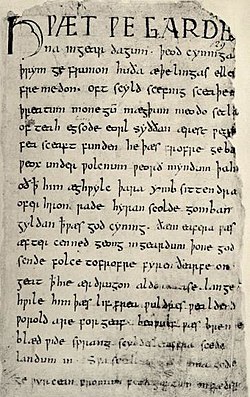
First Page of Beowulf

Block, 9/6 & 7 - Beowulf . . . all day . . .

*P&P

*Discuss J1 - on Chivalry (20-30 min)

*Intro Beowulf and Anglo-Saxon poetry.

*Video

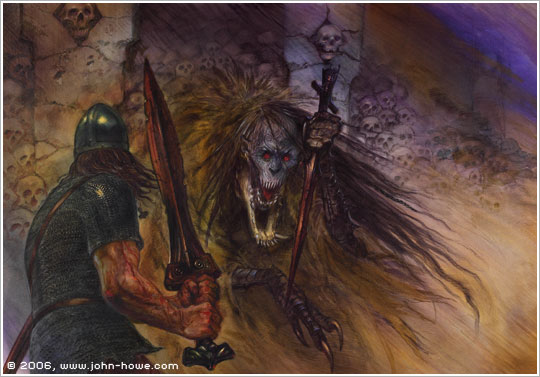
Beowulf turns Grendel into a
twelve piece bucket of KFC


*As you read, keep in mind that Beowulf was written as a Geatish story-manual on what it means to be a good king, what it means to be chivalrous. Keep your eyes on places in the text where you see this explicit ("Behavior that's admired is the path to power among people everywhere.") and where implicit (Beowulf not grasping the throne from the rightful heir even when it's "lawfully" offered him). 

*Begin Beowulf

HW: 
  • I will be checking to see if you have a three ring binder with properly labeled dividers and a stash of lined paper.
  • Look for prompts from colleges to which you will be applying.

Anglo-Saxon Riddles

Bilbo and Gollum (Smeagol) Riddle Jousting
Perhaps some of you will remember a familiar name, J. R. R. Tolkien, and his delightful work The Hobbit, in which a smallish, Englishy creature named Bilbo finds himself in a fusty cave, fighting for his life by riddle-jousting with the hungry-for-hobbit Smeagol. Tolkien took so much of what he wrote from Anglo-Saxon culture, riddles not excepted. 

Why did Anglo-Saxons love riddles, word games? Perhaps because hunting for treasure was in their blood, as was beautifully wrought treasure itself. Poetry is a kind of riddle, a word-treasure to admire, and in the struggle for and discovery of its meaning doth its beauty shine forth ; )

As you try your hand at these Anglo-Saxon riddles below, keep in mind that the answers to these riddles are generally concrete things (a bird, a castle, an egg) as opposed to abstract ideas (love, joy, hate).

Enjoy!


Anglo-Saxon Mnemonic Devices

*Here are several mnemonic (memory) devices to help you remember important people groups and historical phases of the isles up to the Norman Invasion in 1066, when English and its language shifted from its Germanic roots to becoming French fried.