Block, 10/31 (11/1) - The Wife of Bath's Tale

Wife of Bath
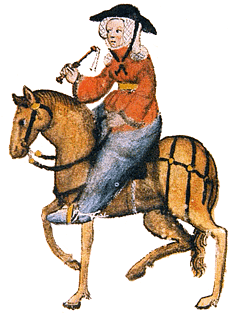
The Wife of Bath
  • P&P
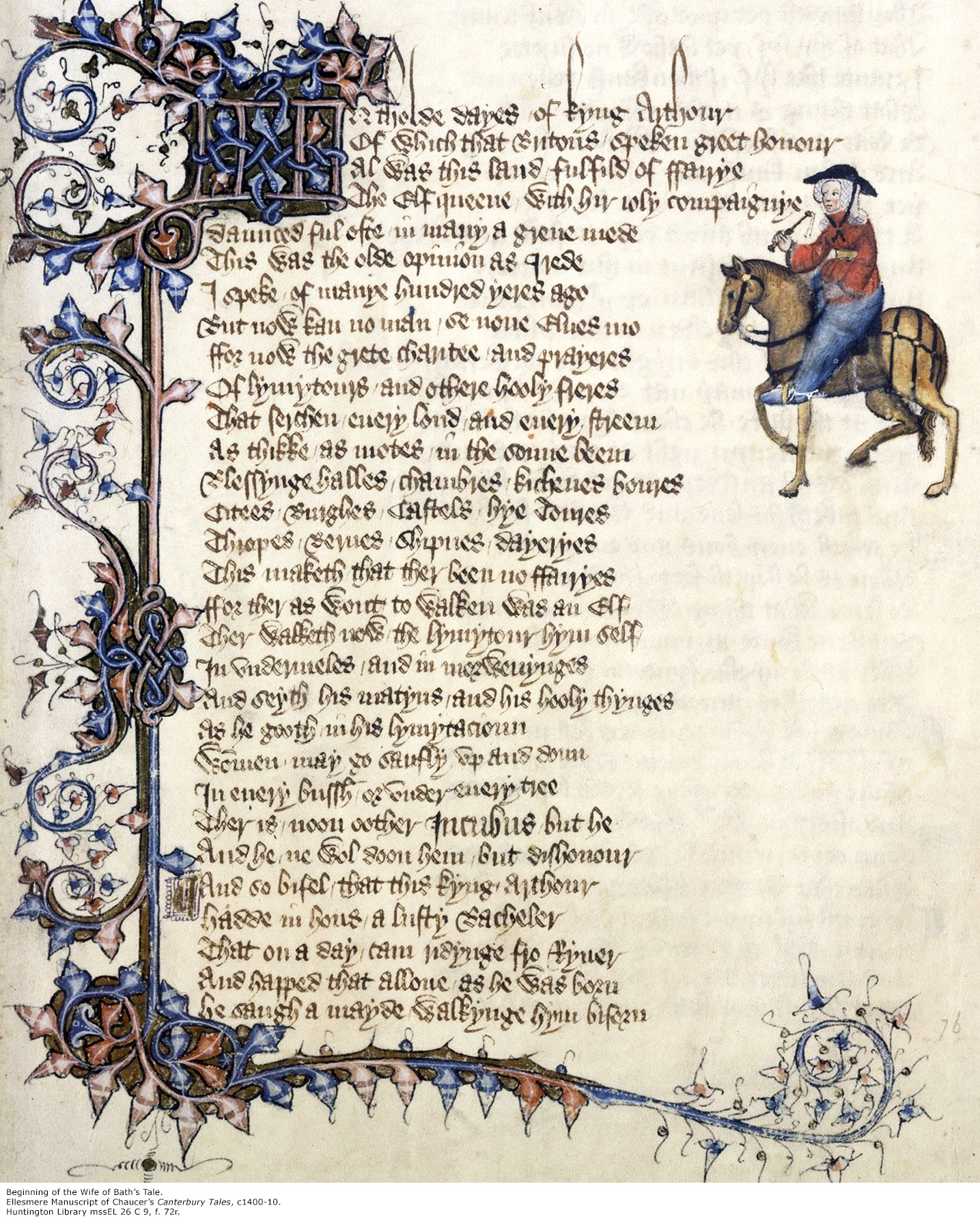
  • G.U.M. - treat the following quote (lines 150-153 from "The Wife of Bath's Tale") as if you were writing an essay. Thus, introduce the quote with a signal phrase (a phrase that introduces the quote). :
    • King Midas wife whispered "Betray me not o water with thy sound to thee alone i tell it, it appears my husband has a pair of asses ears"!

  • J6 - "The Wife of Bath's Tale." 
    a. What were the knight’s crimes, his original sentence, and his second sentence? 
    b. What bargain do the knight and the old woman strike? 
    c. What payment for her help does the old woman demand, and what is the knight’s response? 
    d. What final choice does the old woman offer the knight at the end of the tale? What is his response?
     
    Shaping Interpretations 
    1. The knight’s quest is to find out what women want. What irony do you see in this? 
    2. In lines 276–278, the knight moans about having the old woman for his wife. How does she respond to each objection he raises? 
    3. How does the knight’s response to the choice given him by the old woman show that he’s learned his lesson about what women want? 
    4. (answer at least TWO of the questions below) No doubt the following Bible verses provide an important aspect of the background for this tale: so . . . read these verses. Now for the questions: Considering the Wife of Bath's character/history, 
    1. What do you think would be her view of the scriptures above? 
    2. In what ways does her tale militate (argue) against Genesis 3:16?
    3. In what ways does her tale reflect the truth of Genesis 3:16? 
    4. In what ways is the Biblical injunction for wives to submit to their husbands misunderstood and/or misapplied?
    5. How could her tale be read as a criticism of those who might pigheadedly misinterpret the Biblical mandate for wives to submit to their husbands?
    6. What is the deep wisdom you've learned from the old lady in the tale?
     

Wednesday, 10/30 - Washing Oneself after a dip in the "Bath"

The Wife of Bath
  • P&P
  • Please have J5 out so I can spot check it. As I walk around, please do the daily assignment below.
  • G.U.M. (Grammar, Usage, and Mechanics) - This is the first daily grammar exercise. When you arrive to class, quietly check the blog and copy down the sentences you see here as I've written them. Then you will make any edits to correct any grammar, usage, and/or mechanics errors you find. Then we will discuss as a class. 
    • And please dont be offended at my views They're really only offered to amuse  
  • When you're finished, please copy down Lesson 2 Latin Roots, which you can find on the right column of the blog (it's called "Roots").
  • Now let's discuss J5 - "The Pardoner's Tale"
HW: Update notes in your binder (Canterbury Tales notes, grammar notes, and Latin Roots Lesson 2). 


Tuesday, 10/29 - Fighting Death with death

William Blake's Pardoner in The Canterbury Pilgrims (1810)
  • P&P
  • Reminders
    • Today's tweaked schedule
    • Nails are posting in different order: the newest are at the bottom now
    • Journals available as a link on the right side of the blog


J5 - "The Pardoner's Tale"
1. How does the Pardoner describe his own character and morals in his Prologue? 
2. According to “The Pardoner’s Tale,” why are the three young rioters looking for Death?
3. Where does the old man tell the three rioters to look for Death? How do they treat him? 
4. Describe the rioters’ plan for the gold and how it proves fatal to all three men. 
5. Why do the Pardoner and the Host quarrel at the end of the tale? Who patches up their quarrel? 
6. How do the tavern knave and the publican personify Death? What does the rioters’ response to the description tell you? 
7. What do you think the poor old man may symbolize
8. Irony is a discrepancy between expectations and reality. How many layers of irony can you identify in this story? 
9. Why is it ironic that the Pardoner preaches a story with this particular moral? How would you account for the psychology of the Pardoner: Is he truly evil, just drunk, or so used to cheating that he does it automatically? 
10. What do you think Chaucer is satirizing in “The Pardoner’s Tale”? 
11. What moral does the Pardoner want us to draw from his tale? What moral do you think Chaucer wants you to draw from the Pardoner’s tale?

HW: Finish J5 (due Wed)
 

Monday, 10/28 - The Pardoner's Tale

  • P&P
  • Three announcements:
    1. Tomorrow we have a strange twist to our schedule: we will have first period, followed by break, then second period.
    2. Note that the nails are now posting with the newest ones at the bottom, so look there at the beginning of each class. 
    3. I've created a link to all the journals for this year by quarter. Look on the right hand column under "Course Info," and you will find a link that says "Journals (2013-14)." Click on that to see which journals I've assigned.  


HW: Be sure your binder is fully updated. I reserve the right to do a "pop-check" at any time. 

The Canterbury Tales

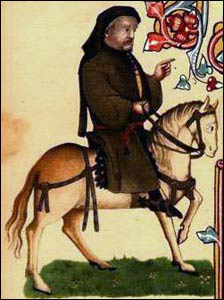
    • Do you like to people watch? Most of us find the human character so peculiar that we can't help but observe, whether it be in Wal-Mart at midnight, a coffee shop in the afternoon, or first period when everyone walks in roaring and looking like a bunch of wookies (teachers not excepted). Wow. That was weird. On to Chaucer (1343-1400), "the Father of English poetry." Chaucer loved to people watch, and his diplomatic post afforded him ample time and opportunity to observe practically every type of human specimen under the Medieval sun. And he wrote about them: elevating some, loving them all, yet eviscerating a number of them--Pardoner and Summoner, anyone?--through his fiction. Before we get into his best-known work, The Canterbury Tales, let's read a quick bio of the man through whose garden of turbulence we will pilgrymage.
    • The Canterbury Tales' Premise: It's spring, and twenty-nine pilgrims are making their way from Southwerk, London to Canterbury Cathedral (to visit the shrine of Thomas Becket). The thirtieth man, the host, decides to join them and to make a wager. Whichever pilgrim can tell the best story to beguile the time as they go will receive a free dinner when they return from their pilgrimage. "The Prologue" introduces the pilgrims, and tales follow. Chaucer never finished the tales, but what we have we treasure.
    Here are links to the following segments of The Canterbury Tales that we will enjoy:
    1. The Canterbury Tales - Prologue (in Middle English)
    2. The Canterbury Tales - Prologue
    3. "The Pardoner's Tale"
    4. "The Wife of Bath's Tale"

    As we read, please take notes in your journal. Pay particular attention to how Chaucer communicates the moral nature of his characters by how they look, act, and speak.

    The Canterbury Tales - General Prologue

    from The Canterbury Tales: The Prologue 
    Geoffrey Chaucer
    translated by
    Nevill Coghill 


    THE PROLOGUE

                When in April the sweet showers fall
                And pierce the drought of March to the root, and all
                The veins are bathed in liquor of such power
                As brings about the engendering of the flower,

    The Canterbury Tales - "The Pardoner's Tale"


    The Pardoner’s Tale
    from The Canterbury Tales
    Geoffrey Chaucer,
    translated by Nevill Coghill 

      The Prologue 

                “But let me briefly make my purpose plain;
                I preach for nothing but for greed of gain
                And use the same old text, as bold as brass,
                Radix malorum est cupiditas. [the root of evil is greed]
    5         And thus I preach against the very vice
                I make my living out of—avarice.

    The Canterbury Tales - "The Wife of Bath's Tale"


    The Wife of Bath’s Tale 

    The Prologue 

                The Pardoner started up, and thereupon
                “Madam,” he said, “by God and by St. John,
                That’s noble preaching no one could surpass!
                I was about to take a wife; alas!

    Canterbury Tales - Middle English


    from The Canterbury Tales: The Prologue, 
    Geoffrey Chaucer 


     Middle English
    (Click HERE for audio)

                Whan that Aprill with his shoures soote
                The droghte of March hath perced to the roote

                And bathed every veyne in swich licour
                Of which vertu engendred is the flour,
    5         Whan Zephirus eek with his sweete breeth
                Inspired hath in every holt and heeth
                The tendre croppes, and the yonge sonne
                Hath in the Ram his half cours y-ronne,
                And smale foweles maken melodye
    10         That slepen al the nyght with open eye,
                So priketh hem Nature in hir corages,
                Than longen folk to goon on pilgrymages, 


     Modern Translation

               When in April the sweet showers fall
                And pierce the drought of March to the root, and all
                The veins are bathed in liquor of such power
                As brings about the engendering of the flower,

    5         When also Zephyrus with his sweet breath
                Exhales an air in every grove and heath
                Upon the tender shoots, and the young sun
                His half-course in the sign of the Ram has run,
                And the small fowl are making melody
    10         That sleep away the night with open eye
                (So nature pricks them and their heart engages)
                Then people long to go on pilgrimages

    Wednesday, 10/23 - New Game Plan

    • P&P
    • Well, I was going to invite you to dine on Chaucer today, but since this salty dawg is a bit weathered, we will defer our feast to block day. So . . .  one more day of being a couch potato for  you. Let's be quite done with Heath Ledger, make a clean break, and put the movie behind us ; )
     HW: Update Middle Ages notes

    Tuesday, 10/22 - Almost to Chaucer . . .

    "We walk in the garden of his turbulence!"
    • P&P
    • Pass back Personal Statements (Beowulf essay is deferred to quarter 2). You will get that back early next week.
    • Today we walk in the garden of his turbulence! Tomorrow we  dine on the parchments of his warfare. (movie today; Canterbury Tales tomorrow).
    HW: be caught up on your notes

    Mundane (Monday), 10/21 - A Knight's Tale

    • P&P
    • Announcement 1: Please pick up your binder if you have not already
    • Announcement 2: the following students must see me during advisory or some other free time today to get a grade on their CWP:
      • Louis Arenal
      • Corinne Grossman
      • Jacob Kimura
      • Kevin McKernan  
    • Before we continue with Heath Ledger's Dark Knight's Tale, I'd like for you to give yourself a number grade for the items below. :
      • Diligence (__/10): Student was on-task upon entering the classroom; checked the blog, updating his/her binder; and refrained from superfluous chit-chat.  Of course, attendance is part of this grade.
        • 7.5/10 is average
      • Discussion (__/10): Student contributed to the quality of discussion, often suggesting answers.  
        • 7.5/10 is average, the occasional comment; not saying anything is 6.5/10. If you want anything more than 7.5, you must give me a reason why.
    •  Mr. Reno will continue to grade, and you will enjoy a bit of laughter and rest for a "job well done" during this first quarter.

    Thursday, 10/17 - Finish Gawain and begin . . . Heath Ledger

      The Joker . . . like you've never seen him
    • P&P
    • Finish BBC Gawain.
    • Begin A (Dark) Knight's Tale
    HW: Finish notes on the terms below using the links provided. One never knows when one will be allowed to use one's notes on one's quiz ; )
     

    Wednesday, 10/16 - BBC Gawain

    • BBC Gawain . . .
    HW: take notes on chivalry and courtly love in Gawain

    Latin Roots

    Latin Roots

    • Lesson 1
      • Roots
        • voc - voice, call
        • dic, dict - say, speak
        • dic, duct - lead
        • loqu - speak
        • loc, locat - place
        • garrul - chatter, talk
      • Prefixes
        • ben, bon - good
        • mal - bad
        • soli, sol - alone, only 

    • Lesson 2
      • Roots 
        • son - sound
        • verb - word
        • ling - language
        • ver - truth
        • vor - eat
        • virtue - strength (inner)
      • Prefixes
        • omni - all
        • multi - many
        • pauci - few
        • long - long
        • brev - short    

    Tuesday, 10/14 - Translating and Tracking Sir Gawain

    • P&P
    • Finish SGGK - take notes answering yesterday's questions:
      • How is SGGK a medieval romance?
      • How does it treat courtly love?
      • How does it treat the code of chivalry? 
    HW: None . . . other than taking notes as you watch the documentary.  

    Journals 2013-14

    Q4

    J14 - TIBE (The Importance of Being Earnest)
    1. Select two quotes from each act (there are three acts) for a total of six quotes.
    2. Explain the surface meaning of the quote and identify the speaker.
    3. Further explain what Wilde is satirizing (making fun of) in Victorian society and/or about its institutions (marriage, Church, education, family, government, etc.)
      • Here is an example of what I'm looking for with your TIBE journal:  
        1. (Quote) LADY BRACKNELL: "You can hardly imagine that I and Lord Bracknell would dream of allowing our only daughter—a girl brought up with the utmost care—to marry into a cloakroom, and form an alliance with a parcel? Good morning, Mr. Worthing!"
        2. (Surface meaning) Lady Bracknell doesn't believe Mr. Worthing's breeding is good enough—nay, it is rather suspect—for her only daughter, who is an aristocrat.
        3. (Underbelly, hidden meaning, satire) What is Wilde satirizing (poking fun at)? Wilde is claiming that many respectable Victorians actually have dubious beginnings, which, if known to the world, would hamper their ability to maintain the benefits of the aristocratic life. Wilde is criticizing the "high pedigree" expectations of the aristocracy as well as what they deem indiscreet behavior, for Lady Bracknell considers Mr. Worthing's origins in a cloakroom at a railway station to be evidence of a concealed social indiscretion (if not in fact, then by association). 

    J13 - P&P Quotes (running journal)

    Q3

     J12 - Logos, Ethos, and Pathos in the Service of the Military 
    1. Identify Johnson's conclusion (his main assertion) and at least one premise that supports his conclusion.
    2. Identify at least one use of logos, ethos, and pathos (three total) in Johnson's article, explaining why each example qualifies as the particular type of appeal.
    3. Identify at least one use of logos, ethos, and pathos (three total) in Smith's article, explaining why each example qualifies as the particular type of appeal.  
    4. Does Smith address any counterarguments to his position? If so, does he concede or refute any of them? 
    5. What is the moral basis of Smith's whole argument (provide a quote that you believe sums it up)?
    6. Can you think of a counterargument to challenge his assumption? 
    7. How would you describe the tone--the author's attitude--of each essay? (Select two adjectives to describe each one)?
    8. Of  logos, ethos, or pathos, which one do you think appeals most to our culture at large today and why?


    Q2 


    J11 - Hamlet, Acts 4-5 (Leithart 150-?)

    1. What are several ways in which Shakespeare shows chaos following in the wake of Polonius's murder? 
    2. How is Ophelia's confusing of Hamlet and Polonius in her songs doubly significant?
    3.  How does Laertes mirror Hamlet? How is his mirroring significantly different, specifically as regards his philosophy of revenge?
    4. How is Claudius like Hamlet's father's ghost?
    5. How does Claudius plan for Laertes to take revenge on Hamlet, and what is significant about this method?
    6. What is the purpose of Act 5 beginning in a graveyard . . . with Hamlet talking to a skull?
    7. Why is it fitting for the play to end with a fencing match?
    8. What is significant about how the major characters die in the final scene? 
    9. What is Fortinbras's situation at the end of the play and why is this significant?

    J10 - Hamlet, Act 3 (Leithart 141-149)

    1. Though fundamentally opposites, how are Ophelia and Claudius similar, according to Leithart?
    2. What tendencies do Hamlet and Claudius share?
    3. How is Claudius a complex character (in other words, how is he more than mere monster)?
    4. What factors contribute to Hamlet's hatred of marriage (and women in particular)?
    5. What is the double-edged nature of the play (what is doubly significant about the death of the player king and his murderer)? In other words, how does the court interpret it? How does Claudius interpret it
    6. What is Claudius struggling with when Hamlet finds him praying? Explain his biblical allusion ("primal eldest curse"), his distinction between earthly and heavenly justice, and his subsequent dilemma (what would be required of true repentance?).
    7. Explain how Hamlet's deliberation in killing Claudius shows us he is increasing in madness (specifically as it pertains to vengeance).
    8. Explain several of the ways in which the death of Polonius is the turning point ("lynch pin") of the play.
    9. What is ironic about Hamlet's attempt to hold up a mirror to Gertrude? What does this tell us about Hamlet's moral constitution?
    10. Given that the murder of Polonius is the murder of another father, what can we expect to see in the immediate future?


    J9 - Hamlet, Act 2 (Leithart 130-139)
    1. Why does Act 2 begin with Polonius's seeming impertinent dialogue with Reynaldo? 
    2. What are the two results of spying?
    3. What is extremely significant about the ambassadors' news upon returning from Norway (and what does it have to do with Hamlet)?
    4. What is so significant about Hamlet's alleged madness? In other words, why is everyone so concerned about him?
    5. What are the theories concerning Hamlet's madness and who holds each theory?
    6. What is Hamlet's purpose behind his "verbal fencing"?
    7. What are the implications to Hamlet's calling Polonius a "fishmonger"?
    8. Explain the meaning behind Hamlet's warning to Polonius: "For if the sun breed maggots in a dead dog, being a god kissing carrion--Have you a daughter? . . . Let her not walk i' the sun. Conception is a blessing, but as your daughter may conceive--friend' look to 't."
    9. Explain why Hamlet reacts so emotionally upon hearing the first players speech. 
    10. How will the play The Murder of Gonzago relate to the theme of spying?


    J8 - Hamlet, Act 1

    Read Leithart (pgs. 120-129) and answer the following questions (Remember that Leithart is the PDF posted on Focus that you used to do J6):
    1. What dramatic and thematic purposes does Fortinbras, the young prince of Norway, serve? 
    2. Contrast the late King Hamlet (the ghost) with Claudius (his brother and present King of Denmark).
    3. What is significant (and ironic) about fathers, particularly about most of the fathers in this drama?
    4. How does Shakespeare develop the theme that appearances sometimes mask reality (cite two examples)?
    5.  What is the purpose of Shakespeare's "ghosts"?
    6. Discuss the important question concerning the "nature" of the ghost (where it comes from) and how we know. 
    7. How was King Hamlet killed? What imagery does the ghost use to describe his death, and why is this (biblically) significant? 


    J7 - Intro to Tragedy and Hamlet

    Read Leithart (document posted on Focus) pages 111-120 and answer the following questions:

    Introduction: Tragedy (111-113)

    1. According to the Greek philosopher Aristotle, what makes a drama a tragedy?
    2. What kind of protagonist is generally required for a successful tragedy and why? 3. List several of the ways that Shakespearean tragedy differs from Sophoclean (or Greek) tragedy.
    4. Given that the shape of Hamlet is a "Fall story," what types of characters, events, and ideas ought we to be looking for as we read?


    Introduction: Hamlet (115-120)

    5. Why is Hamlet such a popular drama?
    6. What are two of the minor textual problems in Hamlet? What is one major problem?
    7. Give two examples of the way Hamlet shows signs of compositional unity.
    8. Cite two reasons why Leithart considers Hamlet a drama that condemns the revenge ethic.
    9. Rather than viewing Hamlet as having "contradictions" and "loose ends," Leithart suggests that Shakespeare was making what profound observation?
    10. How is Hamlet healthy reading for those who live in an age "dominated by scientific idolatry"?


    J6 - "The Wife of Bath's Tale." 
    Reading Check 
    a. What were the knight’s crimes, his original sentence, and his second sentence? 

    b. What bargain do the knight and the old woman strike? 

    c. What payment for her help does the old woman demand, and what is the knight’s response? 

    d. What final choice does the old woman offer the knight at the end of the tale? What is his response? 
     

    Shaping Interpretations 

    1. The knight’s quest is to find out what women want. What irony do you see in this? 

    2. In lines 276–278, the knight moans about having the old woman for his wife. How does she respond to each objection he raises? 

    3. How does the knight’s response to the choice given him by the old woman show that he’s learned his lesson about what women want? 

    4. (answer at least TWO of the questions below) No doubt the following Bible verses provide an important aspect of the background for this tale: so . . . read these verses. Now for the questions: Considering the Wife of Bath's character/history, 
    1. What do you think would be her view of the scriptures above? 
    2. In what ways does her tale militate (argue) against Genesis 3:16?
    3. In what ways does her tale reflect the truth of Genesis 3:16? 
    4. In what ways is the Biblical injunction for wives to submit to their husbands misunderstood and/or misapplied?
    5. How could her tale be read as a criticism of those who might pigheadedly misinterpret the Biblical mandate for wives to submit to their husbands?
    6. What is the deep wisdom you've learned from the old lady in the tale?
     
    J5 - "The Pardoner's Tale"
    1. How does the Pardoner describe his own character and morals in his Prologue?
    2. According to “The Pardoner’s Tale,” why are the three young rioters looking for Death?

    3. Where does the old man tell the three rioters to look for Death? How do they treat him? 

    4. Describe the rioters’ plan for the gold and how it proves fatal to all three men. 

    5. Why do the Pardoner and the Host quarrel at the end of the tale? Who patches up their quarrel? 

    6. How do the tavern knave and the publican personify Death? What does the rioters’ response to the description tell you? 

    7. What do you think the poor old man may symbolize

    8. Irony is a discrepancy between expectations and reality. How many layers of irony can you identify in this story? 

    9. Why is it ironic that the Pardoner preaches a story with this particular moral? How would you account for the psychology of the Pardoner: Is he truly evil, just drunk, or so used to cheating that he does it automatically? 

    10. What do you think Chaucer is satirizing in “The Pardoner’s Tale”? 
    11. What moral does the Pardoner want us to draw from his tale? What moral do you think Chaucer wants you to draw from the Pardoner’s tale?

    Q1


    J4 - Beowulf Prompts: Take a look at the following journal prompts and select two of them in order to compile information for a possible essay. Consider this assignment the early stages of research. When reading, you must understand not only the plot but also be asking yourself questions that might lead you to an original insight about a work, a thesis statement. We will check your journal (your textual evidence and your own thoughts) next Wednesday.

    1. What is the Beowulf author doing with all his biblical allusions? Keep track of them and figure out his purposes for using them. Why does he include them? What do they add to the tale?

    2. What is the Beowulf author doing by including a bunch of epic tales within this epic tale? Are these merely random insertions to meet an ancient Anglo-Saxon CWP word count or to confuse modern high school students, or do they play larger structural or thematic roles relating to the work as a whole? Consider the tales' moral content, their typologies, and the atmosphere they establish.

    3. What is the Beowulf author saying about the nature of good and evil? Is evil merely something in the heart of creatures lurking "out there" in the wild, or is it something more complex than beast and dragon versus man?

    4. Beowulf is full of contrasts. What are some of the most important ones, and what is the author telling his readers/listeners with these contrasts?

    5. What is the Beowulf author's view of the goodly king? A goodly thane (warrior)? Is there a difference between the two? What is it?

    6. How is Beowulf a tale that attests to a world in religious transition (from pagan to Christian), and what might the author be saying about it?

    7. Beowulf addresses the subject of peace in a culture characterized by war. Address the various attempts at establishing peace and also take a stab at the author's view of whether or not this peace is ever attainable.

    8.  Where do we see the seeds of English chivalry sown and sprouting through this Anglo-Saxon take on a Geatish legend?


    J3 - Intro Paragraphs (MLA formatted)
    1. Write two introductory paragraphs for your two selected prompts.
    2. Be creative by using descriptive language and/or writing a narrative.

    J2 - The College Prompt


    1. Select two prompts to bring to class tomorrow (block day). 
    2. Write them both out in your binder 
    3. Consider whether a descriptive or a narrative essay (or a combination of both) will best help you address each  prompt.

    J1 - Chivalry


    Post image for Is Chivalry Dead?
    What is the etymology of our word "chivalry"?
    1. What words come to mind when you think of the word chivalry? 
    2. Look up the word and write down its etymology (the language and words it comes from).
    3. Tell of a time when you encountered chivalric behavior.
    4. Does our modern American culture wage war against chivalry? Does it encourage it at all? Explain.
    Monday, 10/14 - Ga----wain!

    An awkward senior portrait (wallet size, anyone?)
    • P&P
    • Finish up SGGK (Sir Gawain and the Green Knight)
    • Take notes while we read and after we read. Consider the following:
      • How is SGGK a medieval romance?
      • How does it treat courtly love?
      • How does it treat the code of chivalry?   
    • Tidy up your binder for the binder check tomorrow (see the link on the right column of the blog under Course Info) 
    HW: Binder check 

    Unit 3: The Middle Ages


      • Middle Ages
        • Texts
          • See Brit Lit - Historical Eras/Contexts (in Notability) or get it again in Google Classroom if necessary.
        • Nails
          • What historical event heralded the shift from Old English to Middle English, from the Anglo-Saxon Era to the Middle Ages? When?
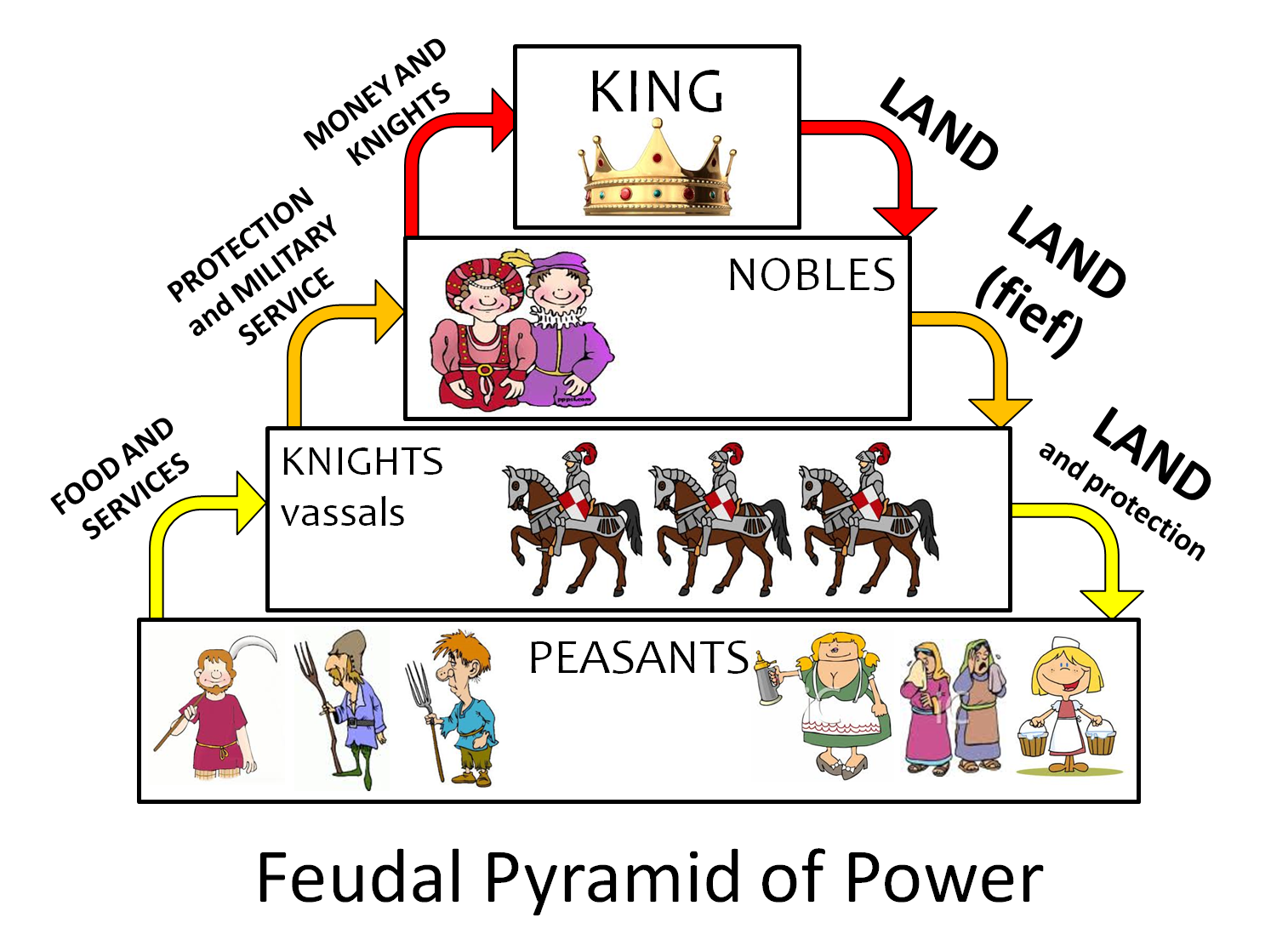
          • What people, ideas, social structures, and events constituted the Middle Ages? 
      • The Pearl Poet (Gawain)
        • Texts
          • Sir Gawain and the Green Knight (SGGK) - available for download at Google Classroom
        • Nails
          • How does the Pearl Poet's work reveal the shift from Anglo-Saxon to Middle English poetic style?
          • What is a medieval romance, and how does SGGK qualify as this genre?
          • How does the Gawain poet use symbols and juxtaposition to show God's grace in the context of the expectations of both the code of chivalry and courtly love?
      • Chaucer
          • How does Chaucer use irony in his tales?
          • How do Chaucer's characters celebrate and satirize Medieval life?
          • How does the personality of the teller select the kind of tale the teller tells?

    Block, 10/10 - The Middle Ages & Arthurian Legend

    The Code of Chivalry included dying well
    • P&P
    • Lit Terms - Middle Ages

    HW: Begin updating Nails using the links above

    Wednesday, 10/9 - Exam Day

      Sir Gawain and the Green Knight
    • P&P 
    • Exam - after you turn your exam in, please begin reading and taking handwritten notes on the Middle Ages section in your Brit Lit - Historical Eras document on Focus (which should already be in Notability). Read only pages 20-32 of the PDF.
    • You must bring either a hard or soft copy of your CWP so I can check it for MLA formatting.

    HW: 
    1. Bring a hard or soft copy of your CWP to me before you turn in your CWP.
    2. CWP (due Friday for everyone). If the MLA formatting is not perfect, I will return it to you.
    3. Read and take notes on the next installment of Brit Lit Eras using the document I've posted on Focus and that you should have already imported into Notability. I will check tomorrow to see that you have handwritten notes.