Monday, 3/31 - Workin' on the Second Generation

  • P&P
  • No GUM. However, continue doing the assignment posted below, which will be due at the end of the week.
  • Reading check 
  • Class work - Second Generation Romantics  

Romanticism - The Next Generation! 
    • Now read the following poems by these remaining second generation romantic poets; jot down the following notes:
      1. Read the first few paragraphs of each Second Generation Romantic's biography and jot down three facts in addition to the poet's years of existence.
      2. What you believe the poem is about 
      3. How it displays romantic traits
      4. A memorable image (give the quote and then tell me which of the following types of imagery it is)
        1. visual - sight
        2. aural - sound
        3. tactile - touch
        4. olfactory - smell
        5. gustatory - taste
        6. kinesthetic - movement
Lord Byron (George Gordon)
George Gordon, Lord Byron (1788–1824) - died at 36


    John Keats
    John Keats (1795–1821) - died at 25
 HW: P&P P3 Ch 6 (48) - do a journal entry for this one

Wednesday, 3/26 - Darcy's little shack

Not a bad little pad, Darcy.
  • P&P
  • GUM (continue from yesterday's GUM): Instead, the Romantics asserted that, reliance upon emotion and natural passions provided a valid and powerful means of knowing and a reliable guide to ethics and living.
  • Continue your poetry reading work
  • Admonition: have a great senior trip! Pursue wisdom and lasting friendship. 
HW: Just read (no need to do journal) P&P P3 Ch 3-5 (45-47) but be ready for a reading check quiz ; )

Tuesday, 3/25 - With My Crossbow I Shot the ALCATRAZ!

With my crossbow I shot the ALCATRAZ!
  • P&P
  • GUM: Romanticism—rejected the earlier philosophy of the Enlightenment—which stressed that logic and reason were the best response humans had in the face of cruelty, stupidity, superstition, and barbarism. 
  • Coleridge's Rime of the Ancient Mariner
    • Take five more minutes to discuss with your colleague the ways in which it displays Romantic characteristics (see yesterday's post for help).
    • Now let's discuss as a class (take notes on what you hear!)
  • Romanticism - The Next Generation! 
    • Now read the following poems by these remaining second generation romantic poets; jot down the following notes:
      1. Read the first few paragraphs of each Second Generation Romantic's biography and jot down three facts in addition to the poet's years of existence.
      2. What you believe the poem is about 
      3. How it displays romantic traits
      4. A memorable image (give the quote and then tell me which of the following types of imagery it is)
        1. visual - sight
        2. aural - sound
        3. tactile - touch
        4. olfactory - smell
        5. gustatory - taste
        6. kinesthetic - movement
Lord Byron (George Gordon)
George Gordon, Lord Byron (1788–1824) - died at 36
 

    John Keats
    John Keats (1795–1821) - died at 25
HW: Finish P&P(due Wed)
  • P2 Ch 19 - P3 Ch 2 (42-44)

Romantic Obsessions

  • The Romantic Movement was essentially a reaction against the reductionist logic of the Enlightenment, the Greco-Roman forms and highfalutin diction of Augustan Era poetry, the mechanistic conception of the universe according to Newtonian physics, and the rigid class hierarchy of the old order that influenced everything.  It championed those traits that the preceding age disparaged: emotion over reason, intuition over empiricism, mystery over science, smudges over straight lines, Nature over civilization, the individual over social class, colloquial speech over professional terminology, the orient over the west, individual opinion over institutional dogma. 

    Consider Star Wars. Think of the Rebellion and everything that Ben Ken-obi, Luke Sky-walker, and Yoda stand for, and you will begin to understand Romanticism (and Gothic literature). Think of the Empire and everything that Darth Vader and the Emperor stand for, and you will begin to understand what the Romantics thought about the Augustan Age (the Age of Enlightenment). 

  • Romanticism's Obsessions (some of the following are contrasts that are not exclusive, but rather give a priority of one over the other):
    • Symbiotic relationship between the imagination and Nature
      • The subjective, inner life of the poet
    • The Sublime - terrifying beauty (think of a volcano or the rugged Alps jutting up like a great white's dorsal fin)
    • Romantic Orientalism - the mysteriousness of the east
    • Ancient ruins - man's fleeting grandeur surpassed by Nature's permanence
    • Intuition and spontaneous feeling over rationalism and premeditated thought
    • Creativity over logic
    • Individual freedom over social law
    • Mortality, mystery, supernaturalism 
    • Solitary sufferer 
     
  • Other Romantic characteristics 
    • Romanticism turned away from the eighteenth-century emphasis on reason and artifice. Instead, the Romantics embraced imagination and naturalness. 
    • Romantic-era poets rejected the public, formal, and witty works of the previous century. They preferred poetry that spoke of personal experiences and emotions, often in simple, unadorned language. 
    • The Romantics each used the lyric as the form best suited to expressions of feeling, self-revelation, and the imagination.
    • Wordsworth urged poets to adopt a democratic attitude toward their audiences; though endowed with a special sensibility, the poet was always “a man speaking to men.” 
    • Many Romantics turned to a past or an inner dream world that they felt was more picturesque and magical than the ugly industrial age they lived in.
    • Most Romantics believed in individual liberty and sympathized with those who rebelled against tyranny.
    • The Romantics thought of nature as transformative; they were fascinated by the ways nature and the human mind “mirrored” the other’s creative properties.

Block, 3/20 - Rimin' and Stealin'

    Landed Gentry: untitled members
    of the landowning upper classes
  • P&P
  • GUM: Both the Industrial Revolution and colonialism expanded England's economy during its Regency period [1810 1820] changing its social structure. Although many new-money, upper, class families known as the landed gentry did not hold hereditary titles. They commonly considered themselves to be: on the same social level as the traditional, landed aristocracy due to their wealth and possessions. 
  • P&P theme workshop - Remember that a theme is one sentence that sums up what an author is telling readers about some aspect of life. Here are some guidelines from Perrine's Literature to help you observe a story's theme:
    1. "Theme should be expressible in the form of a statement with a subject and a predicate."
    2. "The theme should be stated as a generalization about life."
    3. "We must be careful not to make the generalization larger than is justified by the terms of the story."
      1. "Terms like every, all, always should be used very cautiously; terms like some, sometimes, may are often more accurate."
    4. "Theme is the central or unifying concept of a story."
    5. "There is no one way of stating the theme of a story."
    6. "We should avoid any statement that reduces the theme to some familiar saying that we have heard all our lives, such as 'You can't judge a book by its cover.'"
    7. Reno would add that with a large story (a novel) there may be many themes an author portrays.
  • Get into groups of three
  • Discuss P2 Ch 14 (37) and come up with as many topics, subtopics, and themes that you think the chapter addresses. Here is an example of what I'm after:
      • Topic - love
      • Subtopic (what kind?) - romantic love
      • Cliche? - Love is blind (do not use a cliche as a theme)
      • Theme (what about romantic love?) - Austen's Pride and Prejudice develops the theme that romantic interest often obscures the vision and critical observation of those who are in the grip of attraction.
  • STC - Rime of the Ancient Mariner (finish)
HW: P&P P2 Ch 17-18 (40-41)
    • Be sure to write out a theme the "real" way now for each chapter ; )
 

Wednesday, 3/19 - Salty Dawg

  • P&P
  • P&P - Discuss P2 Ch 12-13 (35-35)
  • STC - The Rime of the Ancient Mariner (see yesterday's post)
HW: P&P - P2 Ch 14-16 (37-39)

Tuesday, 3/18 - STC, baby

Gerard Manley Hopkins
"As kingfishers catch fire . . ."
  • P&P
  • Let's rap P&P for a moment
  • Have you ever done something inexplicable? You knew you shouldn't do it but did it just because you could? Do you like the sea? No? Well, we're going. Do you like weddings? Well, too bad! We don't get to go to this wedding. We get accosted by a yarn-spinning ol' piece of nasty salty sea dog. You ready? Didn't think so. Let's go!
  • Samuel Taylor Coleridge
HW: P&P P2 Ch 12-13 (35-36)

Monday, 3/17 - P&P one more time

  • P&P
  • Today I'm wrapping up grades, so I'm going to let Lizzy Bennet and Mr. Darcy provide the babysitting ; )
HW: 
  • P&P P2 Ch 10-11 (33-34)
    • Remember that, rather than sharing why you like a passage, you must now do one of the following:
      1. connect the quote to one of the themes Austen is developing.
        1. What is a theme? It is a one sentence statement that gives an author's view on some aspect of life.
          1. Even when presumably "under good regulation," pride still tends to damage others. 
      2. you may comment on how Austen is developing her characters (whether directly or indirectly). Is Lizzy changing? If so, how? Mr. Darcy? Does your quote solidifying what you already knew of a character?
 

Block, 3/12 & 13 - Last day of the second to last quarter

  • P&P
  • Binder check day
  • Video 
    • Romantics "Nature" (18:44-39:40) - Coleridge and Wordsworth
    • Pride & Prejudice . . . the next installment!
HW: P&P Part 2 Chapters 5-9 (28-32)

Tuesday, 3/10 - I've heard several students call them "Resuscitations"

  • P&P
  • Resuscitations ; )
  • Finish Wordsworth's poems posted yesterday
HW: 
  1. Don Satan rewrites (due Block)
    1. First and third periods, that means tomorrow!
  2. Binder Check (Block)
  3. P&P - take a break (I'll assign your next installment over the weekend ; )

Monday, 3/10 - Last week of Q3

Have sight of Proteus rising from the sea
  • P&P
  • Poetry Recitations
  • William Wordsworth
HW: 
  1. Poetry Recitations tomorrow
  2. P&P Part 2 Ch 3-4 
  3. Don Satan rewrites: due Wed and Thurs of this week. 

Block, 3/6 & 7 - More Romanticism

Westminster Bridge (London)
  • P&P
HW: 
  1. If you'd like, you may do a rewrite of your Don Satan essay for up to 1/4 of the points back that you lost. It must be money! 
    1. Due date? Next Tuesday.
    2. MLA formatted
    3. Hard copy
    4. Changes highlighted
  2. P&P (attention! There are two ways to "chapterize" this book. 
    1. For those reading books that have chapters 1-61, please read Chapters 21-25
    2. For those reading Subtext or books with Parts 1-3, please read the following chapters:
      1. Part 1 Chapters 21-23 
      2. Part 2 Chapters 1-2

Wednesday, 3/4 - More B-lak-ay

  • P&P
  • P&P Ch 16-17 questions?
HW: P&P Ch 18-20

Tuesday, 3/4 - The African Children's Choir Extended Chapel

  • P&P
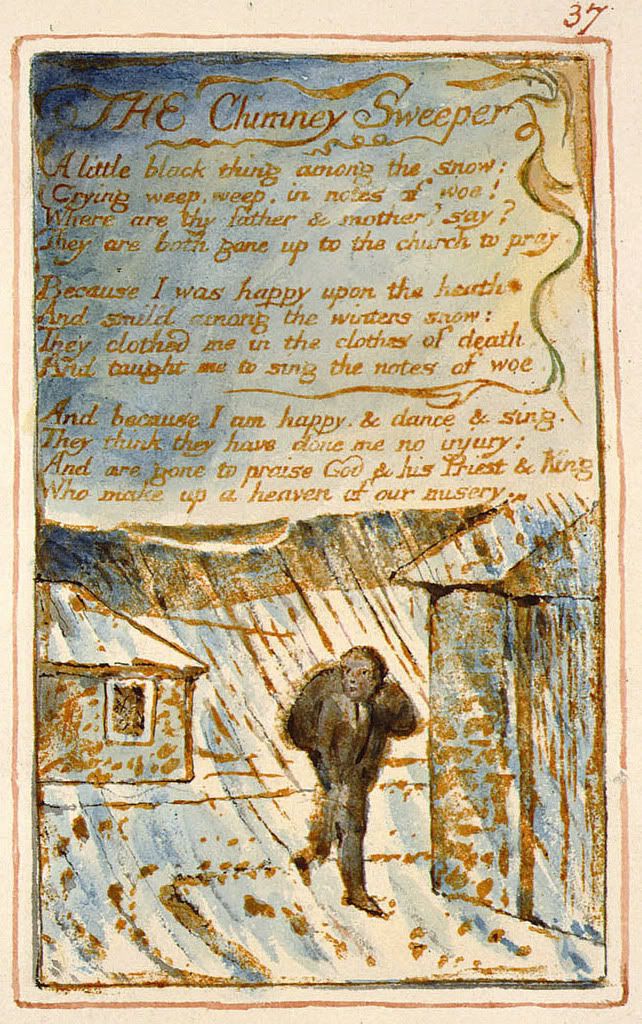
  • Begin reading William Blake's "Chimney Sweeper" poems, and in your notes section of your binder answer the Shaping Interpretations questions (2-9). Once you read through the poems several times on your own, you may work with a friend.
  • HW: 
    • Finish "Chimney Sweeper" notes
    • Next installment of P&P - Ch 16-17

Monday, 3/3 - B-lock-ay. William Blake

  • P&P
  • GUM & HW check: Many Romantic poets believed the poet to be more than mere reformers for William Blake for example the poet was the bard an inspired revealer.
HW: Read P&P 14-15