Block, 1.29 & 30 - "Girls with Geartars"

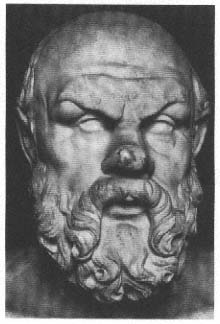
Socrates . . . at her death ; )
  • 3PO
  • Discuss HW
  • Discuss the terms of argument: P1 + p2 = C
    •  premise - an assertion that supports a conclusion
      • P1: All men are mortal
      • p2: Socrates was a man
    • conclusion - the main assertion that follows from a premise or premises
      • C: Therefore, Socrates was mortal
    • counterargument - an opposing viewpoint or premise
      • Premise 1 CA - A few men never died
        1. According to Hebrews, Enoch was taken to heaven before he died
        2. Elijah was taken directly to heaven in a fiery chariot
        3. Jesus lives forever
      1. premise 2 CA - Socrates was not a man; he was a woman
      2. Conclusion CA - Socrates is immortal; he lives through Plato's writings!  
      Pugrates
    • Concession (to concede) - an acknowledgment of the merit of a counterargument
      1. Even if I grant that Socrates was not a man (this is the concession part) but was a woman, this point still doesn't change the fact that the person of whom we are speaking died by drinking hemlock. Socrates' mortality is at the heart of the debate, and since (s)he died, my conclusion still stands. We could also readjust my argument's premises: All "featherless bipeds" (humans) are mortal; Socrates was a "featherless biped" (woman); therefore, Socrates was mortal.
    • Refutation (to refute) - a discrediting of a counterargument
      1. It is impossible for your counterargument to stand; no woman could ever be as ugly as he (look at his little pug-faced picture over yonder for proof).
Journal: "Girls with (Gear)tars": Women in Combat
      1. (Johnson) Identify Johnson's conclusion (his main assertion) and at least one premise that supports his conclusion.
      2. Identify at least one use of logos, ethos, and pathos (three total) in Johnson's article, explaining why each example qualifies as the particular type of appeal.
      3. (Smith) Identify at least one use of logos, ethos, and pathos (three total) in Smith's article, explaining why each example qualifies as the particular type of appeal.  
      4. Does Smith address any counterarguments to his position? If so, does he concede or refute any of them? 
      5. What is the moral basis of Smith's whole argument (provide a quote that you believe sums it up)?
      6. Can you think of a counterargument to challenge his assumption? 
      7. How would you describe the tonethe author's attitude—of each essay? (Select two adjectives to describe each one)?
      8. Of  logos, ethos, or pathos, which one do you think appeals most to your generation today and why? 
HW:

  1. Finish the journal for Monday 


Wednesday, 1.28 - A Maw o' Death Proposal


gaping_maw
 A Maw o' Death Proposal
  • 3PO
  • GUM: Go to U5 above and begin writing down the nails and lit terms
  • Reno to check HW
    • Milton and U5 notes
  • Finish Swift's Modest Proposal
    • Work with someone next to you to find two examples (a particular quote or paraphrase) of each of the following types of persuasive appeal (and explain how each qualifies as the specific type of appeal):
      • How does Jonathan Swift use logos (logical appeals) to develop and support his argument?
      • How does Jonathan Swift use ethos (ethical appeals) to develop and support his argument?
      • How does Jonathan Swift use pathos (emotional appeals) to develop and support his argument? 
HW: Finish the above assignment for block

Tuesday, 1.27 - A Modest Proposal


  • 3PO
  • How to argue
  • Intro: Jonathan Swift's Modest Proposal (in GC)
  • Work on your assignments due tomorrow

HW: 
    1. (Wed) Paradise Lost Q1-11
    2. (Wed) Notes: The Restoration and the 18th Century
      1. Take notes on the fourteen sections (which includes the introduction): one Topic Sentence and at least one detail for each section.

    Monday, 1.26 - Apologia pro Apology


    • 3PO
    • I'm sorry that I did not officially make an assignment through Focus reminding you to finish the opening selection of Paradise Lost. Since I did not do so, I cannot hold it against you ; )
    • Let's finish PL in class and the eleven questions. You are responsible to have them finished by Wednesday. 
    • Begin Brit Lit - Historical Eras on "The Restoration and the 18th Century" 
      • Take notes on the fourteen sections: one Topic Sentence and at least one detail for each section. Due Wednesday.
    HW: 
    1. (Wed) Paradise Lost Q1-11
    2. (Wed) Notes: The Restoration and the 18th Century
      1. Take notes on the fourteen sections (which includes the introduction): one Topic Sentence and at least one detail for each section.

    Block, 1.22 & 23 - To justify God's ways to man

    • 3PO
    • Review lit terms (epics and their characteristics)
    • Paradise Lost (in GC but we will use nasty purple texts for author's bio and intro to text, pg. 361-64) - Two options
      • Have Reno play the audio and lead you through the text OR
      • in groups of three or four, read through line 270, answering the numbered (1-11) and italicized questions in the margins of the text in your journal as you go. I will do a cursory check of your group progress as you go. 
    • Begin reading and taking notes on Brit Lit Eras: The Restoration and the 18th Century. 
    HW: Finish Restoration notes - one topic sentence for each section and one to two details

    Wednesday, 1.21 - The Restoration


    Tuesday, 1.20 - Students aren't Time's fools, though essay's due date 'proacheth like a scythe


    • 3PO
    • ANNOUNCEMENT: Hard copy due at the beginning of class.
      • If it's complete with MLA perfect, I'll grant one extra credit point. 
      • If it's complete but MLA is imperfect, you have one more day to format properly with no deduction. 
      • If it's not turned in or incomplete, it's minus 20% for the first day and an additional 10% each subsequent day.
    • Work day - Shakespeare Today link and help.
    HW: Finish essay (hard copy due). Don't forget to submit a copy to turnitin.com.

    Block, 1.15 & 16 - Testing . . . 1, 2, 3


    • 3PO
    • Test - Much Ado
    • MLA formatting your first page
    • Work on your Shakespeare Today Essay (please note that I've consolidated the hyperlinks to the texts farther down the page).
    HW:
    1. No school Monday
    2. (Wed) Shakespeare Today Essay due
      1. Bring a hard copy to class
      2. Submit an electronic copy to turnitin.com
        1. If you are absent, you still must submit a e-copy to turnitin.com to show that it's completed. Then bring a hard copy when you return.

    Wednesday, 1.14 - Sigh no more about your essay; work on it


    • 3PO
    • GUM: Use the following information to write out a sentence that uses a signal phrase, the quote, and parenthetical (in-text) citation:
      • (1)
        • Speaker: Don John
        • Audience: Borachio and Conrade
        • Context: discussing Claudio and Hero's intended wedding
        • Act I, Scene III
        • Quote: 
          • this may prove food to 
          • my displeasure. That young start-up hath all the
          • glory of my overthrow: if I can cross him any way, I        390
          • bless myself every way.
    HW: Study for Much Ado test on block ; )

    Tuesday, 1.13 - Cite no more, no more

    • 3PO 
    • Reminders 
      • Much Ado test on block day
      • New due date for Shakespeare essay since we have not school on Monday (MLKJDay): Wed. Jan. 21st 
    • GUM (10 min)
      • Parenthetical (or in-text) Citations (from Bedford 59e): 
        • Read the introductory selection from Bedford 59e and then use the blog link to do the activity below (to get there, please follow the steps below):
          • blog 
          • right column
          • "Course Info" 
          • "Bedford Online"
          • "Researched Writing"
          • "59: Writing about Literature"
          • "59e: Integrate quotations from the work"
      • GUM cont'd: Using Bedford 59e as a guide, identify what is incorrect (there may be more than one error) about each of the following citations and then correct it in your journal (be ready to discuss):
        1. Shakespeare says, "This above all—to thine own self be true [1.3.564].
        2. "This above all," said Polonius, "—to thine own self be true. (1.3.564)
        3. Polonius's advice to Laertes: "This above all—to thine own self be true" (1.3.564).
        4. Polonius's following his own pedantic advice to Laertes ironically leads to his death: "This above all— to thine own self be true" (1.3.564).
    • Some links for writing about literature
    • Continue Shakespeare Today Essay
      • Go to Google Classroom
      • One person create a Google Doc
      • Whoever does not create it must be invited to edit
      • Do NOT invite me; I already invited myself to the party via GC ; ) 
    HW:
    1. (block) Much Ado quiz-test (quest)
    2. (Wed. 1.21) Shakespeare Today Essay  

    Monday, 1.12 - Much Ado about Writing


    HW: 
    1. (Tues) Your audience and proposed wisdom via GC.
    2. Prepare for a Much Ado test on block day
    3. (Next Tues.) Essay due

    Shakespeare Today


    Shakespeare Today Essay


    Rationale: I am convinced that Shakespeare is worth reading, but I believe this neither because I’m supposed to as an English teacher nor because I believe difficult things are necessarily worth doing (sometimes they’re not, although things worth doing are often difficult). One of the reasons  I believe he is worth reading is that his plays contain deep, stylish wisdom, wisdom hidden, wisdom worth searching out. His craft displays what Sir Philip Sydney, Renaissance poet and scholar, deemed the purpose of poetry (a speaking picture): "to teach and delight" ("A Defense of Poesy" par. 13). The Bible says that “It is the glory of God to conceal a matter,  / But the glory of kings is to search out a matter” (Prov. 25.2). Shakespeare, like his Anglo-Saxon forefathers, enjoyed riddling, a form of concealing a matter. Like God who plunged riches into this world for us to search out, Shakespeare plunged riches into his dramas for us as well. However, like worldly riches, wisdom is not to be hoarded and brooded upon Smaug-like; it is, rather, for sharing with others, like a goodly king, like Hrothgar who did not “renege, but doled out rings / And torques at the table” (Beowulf, lines 81-82). Thus, this is your glory, your assignment:

    ·      Work with a partner

    ·      Use links below to either Hamlet and/or Much Ado about Nothing (please feel free to use both if you see the bard developing similar themes).

    ·      In Google Classroom, open a Google Doc and begin a dialogue discussing two things:

    1.     A message: what you believe to be the deep, literary wisdom in Shakespeare’s text(s)

    2.     An audience: a current event, an institution, public officials, an organization, your city, a public figure, or any other appropriate audience who could use that wisdom (someone/group on campus?). Keep your tone respectful, remembering that we are all sinners worthy of some criticism.

    ·   As you refine your discussion, quote the text(s) to support your opinions


    Also record act, scene, and line numbers (2.3.18-21) so you don’t have to look up your sources later. Your next installment of the assignment I'll give to you tomorrow. 


    Here are some more requirements, resources, and guidelines:

      • Introduction
        • greet and address your audience (Dear Mr. President, ) and occasion for writing
          • audience should be a specific person or group of people to whom you could send this letter
            • Dear Mr. President,
            • Dear senior "men" of MVCS's Class of 2015, 
            • Poor Mr. Reno, 
        • name your author and text(s) (italicize major works)
        • thesis statement: the deep wisdom Shakespeare offers this audience (what and how he does it)  
          • you will be graded on the depth of your Shakespearean wisdom
            • boys are stewpyd and smellee (D- . . . F?)
            • don't trust anyone (D+)
            • don't pursue vengeance (B-)     
      • Body (you can do one of two approaches)
        • EITHER integrate literary analysis (at least three in-text citations and other evidence from the text) and cultural commentary/application together into one section of several paragraphs
        • OR do the literary analysis first and then provide the cultural commentary/application once you have established your insights (separate paragraphs)
      •  Conclusion
        • review your deep wisdom
        • graciously appeal to your audience's ear to hear 
        • closing word(s) and signatures
          • Respectfully,
          • Yours forever and a day, (just kidding)
          • Yours for one year and a day (and then you're mine), the green knight ; )       


    Block, 1.8 & 9 - MAaN (Much Ado about Nothing) is a giddy thing

    Man is a giddy thing
    • 3PO
    • Much Ado finish
    • Discuss study guide and play in light of
      • Creation, Fall, Redemption, and Restoration
    • A well-known band inspired by Branagh's rendition of Much Ado
    • Pass back Hamlet essays - read several well-done examples (see GC)
    • Some links for writing about literature

    Tuesday, 1.6 - I am a man of few words


    "Neo" Don John & Co.
    • Work on your sonnet (116)
    • 3PO
    • Continue with Much Ado (study guide available on GC)
    • I will pass back your Hamlet essays on block day so you don't lose them between now and then.

    Monday, 1/5 - Much Ado about Don John


    I decided that rather than toss you into the tar pit of Milton's Paradise Lost to kick off the semester, we would first look at the Satan character from Shakespeare's comedy Much Ado about Nothing. I also didn't want to expose you to the noxious fumes of a Shakespearean tragedy (Hamlet) without reviving you with the delicious air of one of his comedies (Much Ado). I also want to give you a chance either to formally rewrite your Hamlet essay or write a new one using Much Ado

    Before we begin, I have a few questions for you to ponder: have you ever wasted time worrying about something you feared might happen but didn't? Have you ever done something foolish based on what you thought was true but wasn't? It seems only human. 

    To properly understand our play's title, it should be "noted" that the Elizabethan pronunciation of "nothing" sounded like the word "noting," he title sounding like Much Ado about Noting. To note something is to listen intently to and remember it. Thus, Shakespeare's punny title means that big mix-ups happen, lots of fuss is created when people note (listen to and act upon) no-thing (hear-say, rumors, or LIES). We might say that paying attention to what really is nothing oftentimes creates something. Another way to say it is listening to lies creates drama, potential tragedy. 

      Consider the ways this comedy addresses how lies create pain and how goodly trickery creates joy.

      • Although we will watch a film version of the play, here is a link to the text: Much Ado about Nothing
      • Also, go to GC (Google Classroom) and snag the Much Ado Study Guide to fill out while you watch the video.