 |
| Socrates . . . at her death ; ) |
- 3PO
- Discuss HW
- Discuss the terms of argument: P1 + p2 = C
- premise - an assertion that supports a conclusion
- P1: All men are mortal
- p2: Socrates was a man
- conclusion - the main assertion that follows from a premise or premises
- C: Therefore, Socrates was mortal
- counterargument - an opposing viewpoint or premise
- Premise 1 CA - A few men never died:
- According to Hebrews, Enoch was taken to heaven before he died
- Elijah was taken directly to heaven in a fiery chariot
- Jesus lives forever
- premise 2 CA - Socrates was not a man; he was a woman
- Conclusion CA - Socrates is immortal; he lives through Plato's writings!
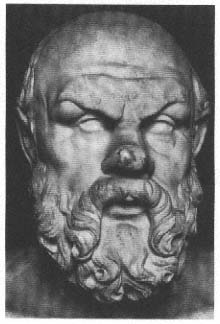 |
| Pugrates |
- Concession (to concede) - an acknowledgment of the merit of a counterargument
- Even if I grant that Socrates was not a man (this is the concession part) but was a woman, this point still
doesn't change the fact that the person of whom we are speaking died by drinking
hemlock. Socrates' mortality is at the heart of the debate, and since
(s)he died, my conclusion still stands. We could also readjust my argument's premises: All "featherless bipeds" (humans) are mortal; Socrates was a "featherless biped" (woman); therefore, Socrates was mortal.
- Refutation (to refute) - a discrediting of a counterargument
- It is impossible for your counterargument to stand; no woman could ever be as ugly as he (look at his little pug-faced picture over yonder for proof).
- Read the following essays:
Journal: "Girls with (Gear)tars": Women in Combat
- (Johnson) Identify Johnson's conclusion (his main assertion) and at least one premise that supports his conclusion.
- Identify at least one use of logos, ethos, and pathos (three total) in Johnson's article, explaining why each example qualifies as the particular type of appeal.
- (Smith) Identify at least one use of logos, ethos, and pathos (three total) in Smith's article, explaining why each example qualifies as the particular type of appeal.
- Does Smith address any counterarguments to his position? If so, does he concede or refute any of them?
- What is the moral basis of Smith's whole argument (provide a quote that you believe sums it up)?
- Can you think of a counterargument to challenge his assumption?
- How would you describe the tone—the author's attitude—of each essay? (Select two adjectives to describe each one)?
- Of logos, ethos, or pathos, which one do you think appeals most to your generation today and why?
HW:
- Finish the journal for Monday

No comments:
Post a Comment