Showing posts with label Restoration and 18th Century. Show all posts

Block, 1.29 & 30 - "Girls with Geartars"

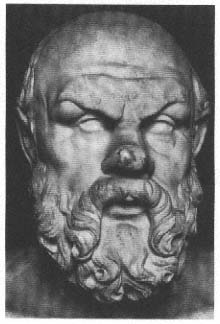
Socrates . . . at her death ; )
  • 3PO
  • Discuss HW
  • Discuss the terms of argument: P1 + p2 = C
    •  premise - an assertion that supports a conclusion
      • P1: All men are mortal
      • p2: Socrates was a man
    • conclusion - the main assertion that follows from a premise or premises
      • C: Therefore, Socrates was mortal
    • counterargument - an opposing viewpoint or premise
      • Premise 1 CA - A few men never died
        1. According to Hebrews, Enoch was taken to heaven before he died
        2. Elijah was taken directly to heaven in a fiery chariot
        3. Jesus lives forever
      1. premise 2 CA - Socrates was not a man; he was a woman
      2. Conclusion CA - Socrates is immortal; he lives through Plato's writings!  
      Pugrates
    • Concession (to concede) - an acknowledgment of the merit of a counterargument
      1. Even if I grant that Socrates was not a man (this is the concession part) but was a woman, this point still doesn't change the fact that the person of whom we are speaking died by drinking hemlock. Socrates' mortality is at the heart of the debate, and since (s)he died, my conclusion still stands. We could also readjust my argument's premises: All "featherless bipeds" (humans) are mortal; Socrates was a "featherless biped" (woman); therefore, Socrates was mortal.
    • Refutation (to refute) - a discrediting of a counterargument
      1. It is impossible for your counterargument to stand; no woman could ever be as ugly as he (look at his little pug-faced picture over yonder for proof).
Journal: "Girls with (Gear)tars": Women in Combat
      1. (Johnson) Identify Johnson's conclusion (his main assertion) and at least one premise that supports his conclusion.
      2. Identify at least one use of logos, ethos, and pathos (three total) in Johnson's article, explaining why each example qualifies as the particular type of appeal.
      3. (Smith) Identify at least one use of logos, ethos, and pathos (three total) in Smith's article, explaining why each example qualifies as the particular type of appeal.  
      4. Does Smith address any counterarguments to his position? If so, does he concede or refute any of them? 
      5. What is the moral basis of Smith's whole argument (provide a quote that you believe sums it up)?
      6. Can you think of a counterargument to challenge his assumption? 
      7. How would you describe the tonethe author's attitude—of each essay? (Select two adjectives to describe each one)?
      8. Of  logos, ethos, or pathos, which one do you think appeals most to your generation today and why? 
HW:

  1. Finish the journal for Monday 


Monday, 1/5 - Much Ado about Don John


I decided that rather than toss you into the tar pit of Milton's Paradise Lost to kick off the semester, we would first look at the Satan character from Shakespeare's comedy Much Ado about Nothing. I also didn't want to expose you to the noxious fumes of a Shakespearean tragedy (Hamlet) without reviving you with the delicious air of one of his comedies (Much Ado). I also want to give you a chance either to formally rewrite your Hamlet essay or write a new one using Much Ado

Before we begin, I have a few questions for you to ponder: have you ever wasted time worrying about something you feared might happen but didn't? Have you ever done something foolish based on what you thought was true but wasn't? It seems only human. 

To properly understand our play's title, it should be "noted" that the Elizabethan pronunciation of "nothing" sounded like the word "noting," he title sounding like Much Ado about Noting. To note something is to listen intently to and remember it. Thus, Shakespeare's punny title means that big mix-ups happen, lots of fuss is created when people note (listen to and act upon) no-thing (hear-say, rumors, or LIES). We might say that paying attention to what really is nothing oftentimes creates something. Another way to say it is listening to lies creates drama, potential tragedy. 

    Consider the ways this comedy addresses how lies create pain and how goodly trickery creates joy.

    • Although we will watch a film version of the play, here is a link to the text: Much Ado about Nothing
    • Also, go to GC (Google Classroom) and snag the Much Ado Study Guide to fill out while you watch the video.

    Wednesday, 2/12 - Testing, testing, 1, 2, 3 . . .

    • P&P
    • When you're finished with your test, please do the second half.
    • When you're finished with that, then prepare quietly until your classmates are finished with their tests. Then you may prepare for your presentations.
    HW: You Modest Proposals are to be presented on block day of this week.

    Tuesday, 2/10 - You must be cruel only to be kind

    • P&P
    • Study Guide: Quiz over The Restoration and the 18th century
      • All Nails and Lit terms (left column of blog)
      • GUM - go over your exercises from class
    • Your modest proposals (we will begin presentations on block day). You must include the following:
      1. Must be a Keynote presentation (or the equivalent)  
      2. Problem  
        1. Identify a particular person or people group suffering an injustice.
        2. Identify the person or group perpetrating the injustice
        3. You may not merely tackle a generic problem like "racism" or "sin."
      3. Solution (Conclusion)
      4. Premises
        1. At least four
        2. Appeals using logos, ethos, and pathos
      5. Counterargument
        1. Either concede
        2. Or refute 

    Monday, 2/10 - Maudistie is the best policie

    • P&P
    • GUM: By the time of Johnson’s death in 1784 the world was changing in disturbing and profound ways the Industrial Revolution was turning English cities and towns into filthy smoky slums. Across the english channel, the French was about to murder a king and set their whole society on a different political course. The eighteenth century was closing, and--just as at the end of the twentieth century, people sensed that a new era was about to begin--people in England knew that the age of elegance, taste; philosophy, and reason; was over.
    HW: 
    1. work on projects (presentations Wed)
    2. Study for quiz (on block day) 

    Block, 2/5-6 - Your Modest Proposals

    • P&P
    • Poetry recitations
    • Discuss J12
    • Begin your Modest Proposals - work in the pairs that you worked in for your Don Satan assignment
    The assignment: to present your own Modest Proposal
    1. Identify a real problem that affects a specific group of people in the world.
    2. Provide an outrageous and appalling solution to the problem (think of the solution as an ironic logical extension inspired by the original problem.)
    3. You must include the following:
      1. premises - at least four reasons that support the proposal
      2. conclusion - this is your proposed solution to the problem
      3. counterargument - at least one viewpoint that pushes against any of your premises or conclusion
      4. either a concession or a refutation (or both) of the counterargument
    4. Be persuasive by using logos, ethos, and pathos
      1. fabricate statistics
      2. identify multiple ways the proposal will benefit all social groups involved
      3. create fictitious "expert" testimony that supports your argument
      4. drop a reason or two that establishes your credibility, shows how concerned you are, and distances you from directly benefiting from the proposal
    5. State your target audience - Who are you poking in the eye?
      1. Remember that Swift was taking aim at England (its politicians and absentee landlords), not the Irish. Rather, he apparently bashed the Irish to help them out. Remember Hamlet's confession to his mother, Gertrude? "I must be cruel, only to be kind." ; )

    Tuesday, 2/4 - You fight like a girl

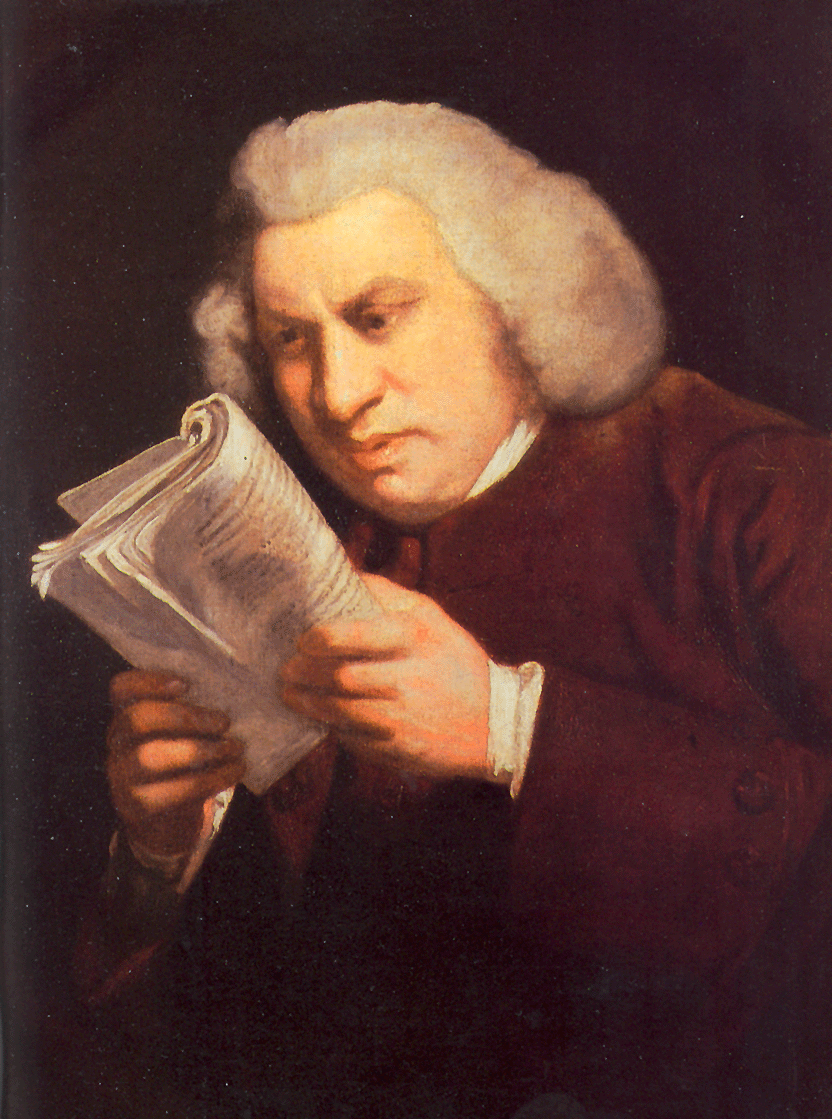
    Samuel Johnson (1709-1784)
    • P&P
    • GUM: Samuel Johnson’s views of humanity were conservative and traditional. He criticizes the popular belief in progress the belief that things are getting better and better and the assumption that men and women are naturally good that is, the notion that if society is reformed, people will automatically do what is right. 
    • Finish presentations
    • Copy down nails into notes.
    • Please copy down the following Lit Terms and their definitions:
      • Premise - an assertion that supports a conclusion
      • Conclusion - the main assertion that follows from a premise or premises
      • Counterargument - an opposing viewpoint or premise
      • Refutation (to refute) - a discrediting of a counterargument
      • Concession (to concede) - an acknowledgment of the merit of a counterargument
    • J12 - Logos, Ethos, and Pathos in the Service of the Military 
    1. Identify Johnson's conclusion (his main assertion) and at least one premise that supports his conclusion.
    2. Identify at least one use of logos, ethos, and pathos (three total) in Johnson's article, explaining why each example qualifies as the particular type of appeal.
    3. Identify at least one use of logos, ethos, and pathos (three total) in Smith's article, explaining why each example qualifies as the particular type of appeal.  
    4. Does Smith address any counterarguments to his position? If so, does he concede or refute any of them? 
    5. What is the moral basis of Smith's whole argument (provide a quote that you believe sums it up)?
    6. Can you think of a counterargument to challenge his assumption? 
    7. How would you describe the tone--the author's attitude--of each essay? (Select two adjectives to describe each one)?
    8. Of  logos, ethos, or pathos, which one do you think appeals most to our culture at large today and why?
    HW: (due block)
    1. Sonnet recitation
    2. Finish J12

    Monday, 2/3 - Your Modest Assessments of the Modest Proposal

    Another Modest Proposal for overpugpulation
    • P&P
    • GUM: Swift was appalled by the squalor and shoddiness [in art, manners, and morals] that underlay the polished surfaces of Augustan life. He felt neither smug or satisfied with the world as many English people did he deplored the corrupt politics of the time, and the growing commercialism, and materialism of the English people.
    • Take 10 minutes to gather as a group and prepare to present your findings:
      • Group 1 - How does Jonathan Swift use logos (logical appeals) to develop and support his argument?
      • Group 2 - How does Jonathan Swift use ethos (ethical appeals) to develop and support his argument?
      • Group 3 - How does Jonathan Swift use pathos (emotional appeals) to develop and support his argument?   
     HW: Study your sonnet (recitation? Block day!)

    Block, 1/29-30 - A Modest Proposal

    • P&P
    • GUM: Today, Alexander Pope and Jonathan Swift, are regarded as the most accomplished literary artists of the early eighteenth century. During their own lifetimes; however, Pope and Swift were frequently out of harmony, with the values of the age, and both often criticized it severely.
      • Break into three groups and identify as many of his appeals as your group can
        1. logos - logic, facts, stats
        2. ethos - author's credentials, appeals to audience, moral ground
        3. pathos - anecdotes, imagery
    HW: 
    1. Study your sonnet (recitation is the end of next week)
    2. Be ready to do a group share on Monday concerning Swift's use of logos, ethos, and pathos in A Modest Proposal.

    Wednesday, 1/29 - The Argument (Logos, Ethos, Pathos)

    "Hello! I'd like to buy an argument." "No you wouldn't."
    • P&P
    • GUM: In 1662 to answer questions about the universe King Charles II chartered a group of philosophers the Royal Society of London for the Promotion of Natural Knowledge. Among other things, it's members called for a kind of writing that was precise, exact, and not decorated with the elaborate, metaphors or odd, allusions of their predecessors.
    • Logos (logical), Ethos (ethical), and Pathos (emotional): the three types of appeals into which Aristotle divided the art of rhetoric, argument, or persuasion.
      • Logos - logical appeals
        • logic (syllogisms), facts, statistics
      • Ethos - ethical appeals
        • moments when and ways in which a writer or speaker addresses how he is qualified, moral, and charitable (i.e. has the audience's best interests in mind)  
      • Pathos - emotional appeals 
        • the use of anecdotes, figurative language, symbols, and images to appeal to an audience's emotions
      • Read Jonathan Swift's A Modest Proposal
        • Discuss uses of logos, ethos, pathos
        • How would you characterize this essay? What is Swift trying to accomplish with it? 
         

          Tuesday, 1/27 - Finish Intro to Restoration and the 18th Century

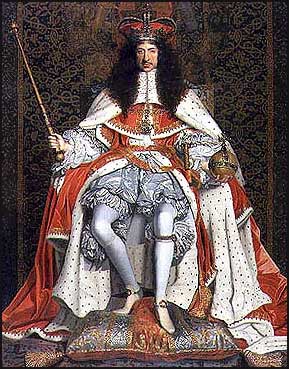
          King Charles II - Monarchy Restored
          • P&P
          • GUM: This long period of time in England_from 1660 to 1800_have been given several labels; the Augustan Age, the Neoclassical period, the Enlightenment, and the Age of Reason. Each of these labels apply to some characteristics of these 140 years; but none applies to all.
          • Finish Intro to the Restoration and the 18th century. 
          HW: Upload a PDF of your essay to Turnitin.com before midnight tonight.

          Unit 5: The Restoration and the 18th Century


          • Intro to the Restoration and the 18th Century
            • Texts 
              • See Brit Lit - Historical Eras/Contexts (in Notability) or get it again in Google Classroom if necessary.
            • Nails
              • What/who were the major events, figures, and ideas during the Restoration and the 18th Century?

          • John Milton
            • Texts
              • Paradise Lost - see GC
            • Nails
              • What is an epic and what are some of its characteristics?
            • Lit Terms
              • epic
              • invocation of the muse
              • in medias res
              • epic simile

          • Jonathan Swift
            • Texts
              • A Modest Proposal - see GC
            • Nails
              • How does Jonathan swift use satire in his proposal?
              • How does Swift use logos, ethos, and pathos to develop his argument?
            • Lit Terms
              • satire
              • logos (logical), ethos (ethical), and pathos (emotional)the three types of appealinto which the Greek philosopher Aristotle divided the art of rhetoricargument, or persuasion.
                • Logos logical appeals
                  • logic (syllogisms), facts, statistics
                • Ethos - ethical appeals
                  • moments when and ways in which a writer or speaker addresses how he is qualified, moral, and charitable (i.e. has the audience's best interests in mind)
                • Pathos - emotional appeals 
                  • the use of anecdotes, figurative language, symbols, and images to appeal to an audience's emotions


          • Samuel Johnson 
          • Ryan Smith
          • Boonin-Kreeft Debate
            • Text (source) - Is Abortion Morally Justifiable in a Free Society?
            • Lit Terms
              • Premise - an assertion that supports a conclusion
              • Conclusion - the main assertion that follows from a premise or premises
              • Counterargument - an opposing viewpoint or premise
              • Refutation (to refute) - a discrediting of a counterargument
              • Concession (to concede) - an acknowledgment of the merit of a counterargument
              • Fallacy (fallacious argument)
                • see the definition and list of fallacies in GC under Unit 5 entitled "WLTC Ch. 6 - Fallacious Arguments"
                • Appeal to (dubious) Authority
                  1. Snob Appeal
                • Appeal to Fear
                • Appeal to Pity
                • Begging the Question
                  1. Loaded Question
                  2. Question Begging Epithet (name calling)
                • Double Standard
                • Equivocation
                • False Analogy
                • False Cause (post hoc)
                • False Dilemma (either/or)
                • Hasty Generalization
                • Personal Attack (ad hominem)
                  • "Tu quoque" (you also)
                • Poisoning the Well
                • Slippery Slope
                • Straw Man
                • Red Herring - introduces an irrelevant topic to lead the debate away from the real topic

          Monday, 1/23 - Intro to the Restoration and 18th Century

          Cool "Russian Doll" Pacman latte
          • P&P
          • Practice John Donne's sonnet while you wait for class to start.
          • Sign up for Turnitin.com. Here are your classes and IDs.  
            • ID 7569972 - English401
            • ID 7569984 - English403
            • ID 7569988 - English405
          • By midnight tomorrow, you must submit your final PDF to turnitin. 
          • Anyone like coffee? Coffee houses? For those of us who do, we have the Middle East and east Africa to thank, as well as England for importing this most exquisite of fruits. To get an idea about the connection between coffee houses, authors, and literature, enjoy this excerpt from William Ukers' massive tome All about Coffee, originally published in 1922: 
          The two most picturesque chapters in the history of coffee have to do with the period of the old London and Paris coffee houses of the seventeenth and eighteenth centuries. Much of the poetry and romance of coffee centers around this time.

          "The history of coffee houses," says D'Israeli, "ere the invention of clubs, was that of the manners, the morals and the politics of a people." And so the history of the London coffee houses of the seventeenth and eighteenth centuries is indeed the history of the manners and customs of the English people of that period. . . .

          The Tatler and the Spectator were born in the coffee house, and probably English prose would never have received the impetus given it by the essays of Addison and Steele had it not been for coffee house associations. Pope's famous Rape of the Lock grew out of coffee-house gossip. The poem itself contains one charming passage on coffee.

          Another frequenter of the coffee houses of London, when he had the money to do so, was Daniel Defoe, whose Robinson Crusoe was the precursor of the English novel. Henry Fielding, one of the greatest of all English novelists, loved the life of the more bohemian coffee houses, and was, in fact, induced to write his first great novel, Joseph Andrews . . .

          The second half of the eighteenth century was covered by the reigns of the Georges. The coffee houses were still an important factor in London life, but were influenced somewhat by the development of gardens in which were served tea, chocolate, and other drinks, as well as coffee. At the coffee houses themselves, while coffee remained the favorite beverage, the proprietors, in the hope of increasing their patronage, began to serve wine, ale, and other liquors. This seems to have been the first step toward the decay of the coffee house.

          The coffee houses, however, continued to be the centers of intellectual life. When Samuel Johnson and David Garrick came together to London, literature was temporarily in a bad way . . .

          It was not until after Johnson had met with some success, and had established the first of his coffee-house clubs at the Turk's Head, that literature again became a fashionable profession.
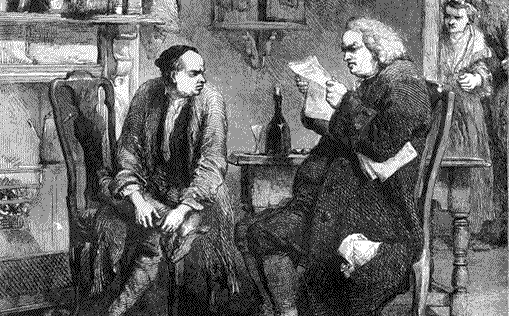
          Samuel Johnson at the Turk's Head Coffee House
          This really famous literary club met at the Turk's Head from 1763 to 1783. Among the most notable members were Johnson, the arbiter of English prose; Oliver Goldsmith; Boswell, the biographer; Burke, the orator; Garrick, the actor; and Sir Joshua Reynolds, the painter. Among the later members were Gibbon, the historian; and Adam Smith, the political economist.


          Certain it is that during the sway of the English coffee house, and at least partly through its influence, England produced a better prose literature, as embodied alike in her essays, literary criticisms, and novels, than she ever had produced before.

          • Thus we embark on a historical overview of this England whose caffeine-steeped literary imagination brewed up some of the strongest satirical beverages on record. Let us begin reading and taking notes on The Restoration and the 18th Century
          HW: 
          1. (due Tues night) Your Don Satan essay must be submitted to Turnitin.com in PDF format by Tuesday night (11:59 PM).

          Wednesday, 1/22 - Roughin' It!

          • P&P
          • I'd like for you to have a rough draft finished by the beginning of block day.
            • Underline thesis statement
            • Underline topic sentences (TS)
            • At least two quotes for the first body paragraph (8-12 sentences)
            • At least two quotes for the second body paragraph (8-12 sentences)
          HW: (due Block) See above requirements

          Tuesday, 1/21 - Keep Goin'!

          • P&P
          • Today I want you to continue working on your Google Drive doc. (5th period, please follow the instructions regarding this in the post below.)
          • Full rough draft is due by the end of the period on Wednesday.
            • Underline your thesis statement (the last sentence of your intro paragraph)
            • Also, please underline your topic sentences (the first or second sentence of each body paragraph)
          • Plan on finishing your essay by the end of block day of this week.
          HW:
          1. (Wed) Full Rough Draft by the end of the period
          2. (Block) Final Draft by the end of the period