 |
| Cool "Russian Doll" Pacman latte |
- P&P
- Practice John Donne's sonnet while you wait for class to start.
- Sign up for Turnitin.com. Here are your classes and IDs.
- ID 7569972 - English401
- ID 7569984 - English403
- ID 7569988 - English405
- By midnight tomorrow, you must submit your final PDF to turnitin.
- Anyone like coffee? Coffee houses? For those of us who do, we have the Middle East and east Africa to thank, as well as England for importing this most exquisite of fruits. To get an idea about the connection between coffee houses, authors, and literature, enjoy this excerpt from William Ukers' massive tome All about Coffee, originally published in 1922:
The two most picturesque chapters in the history of coffee have to do
with the period of the old London and Paris coffee houses of the
seventeenth and eighteenth centuries. Much of the poetry and romance of
coffee centers around this time.
The Tatler and the Spectator were born in the coffee house, and probably English prose would never have received the impetus given it by the essays of Addison and Steele had it not been for coffee house associations. Pope's famous Rape of the Lock grew out of coffee-house gossip. The poem itself contains one charming passage on coffee.
Another frequenter of the coffee houses of London, when he had the money to do so, was Daniel Defoe, whose Robinson Crusoe was the precursor of the English novel. Henry Fielding, one of the greatest of all English novelists, loved the life of the more bohemian coffee houses, and was, in fact, induced to write his first great novel, Joseph Andrews . . .
The second half of the eighteenth century was covered by the reigns of the Georges. The coffee houses were still an important factor in London life, but were influenced somewhat by the development of gardens in which were served tea, chocolate, and other drinks, as well as coffee. At the coffee houses themselves, while coffee remained the favorite beverage, the proprietors, in the hope of increasing their patronage, began to serve wine, ale, and other liquors. This seems to have been the first step toward the decay of the coffee house.
The coffee houses, however, continued to be the centers of intellectual life. When Samuel Johnson and David Garrick came together to London, literature was temporarily in a bad way . . .
It was not until after Johnson had met with some success, and had established the first of his coffee-house clubs at the Turk's Head, that literature again became a fashionable profession.
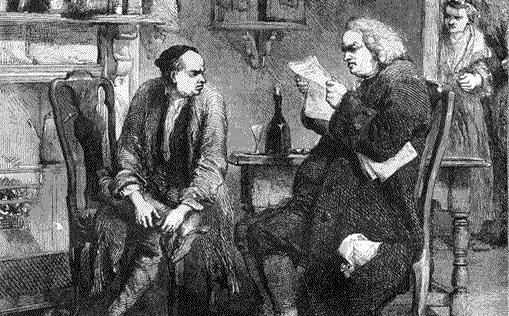 |
| Samuel Johnson at the Turk's Head Coffee House |
Certain it is that during the sway of the English coffee house, and at least partly through its influence, England produced a better prose literature, as embodied alike in her essays, literary criticisms, and novels, than she ever had produced before.
- Thus we embark on a historical overview of this England whose caffeine-steeped literary imagination brewed up some of the strongest satirical beverages on record. Let us begin reading and taking notes on The Restoration and the 18th Century
- (due Tues night) Your Don Satan essay must be submitted to Turnitin.com in PDF format by Tuesday night (11:59 PM).
