 |
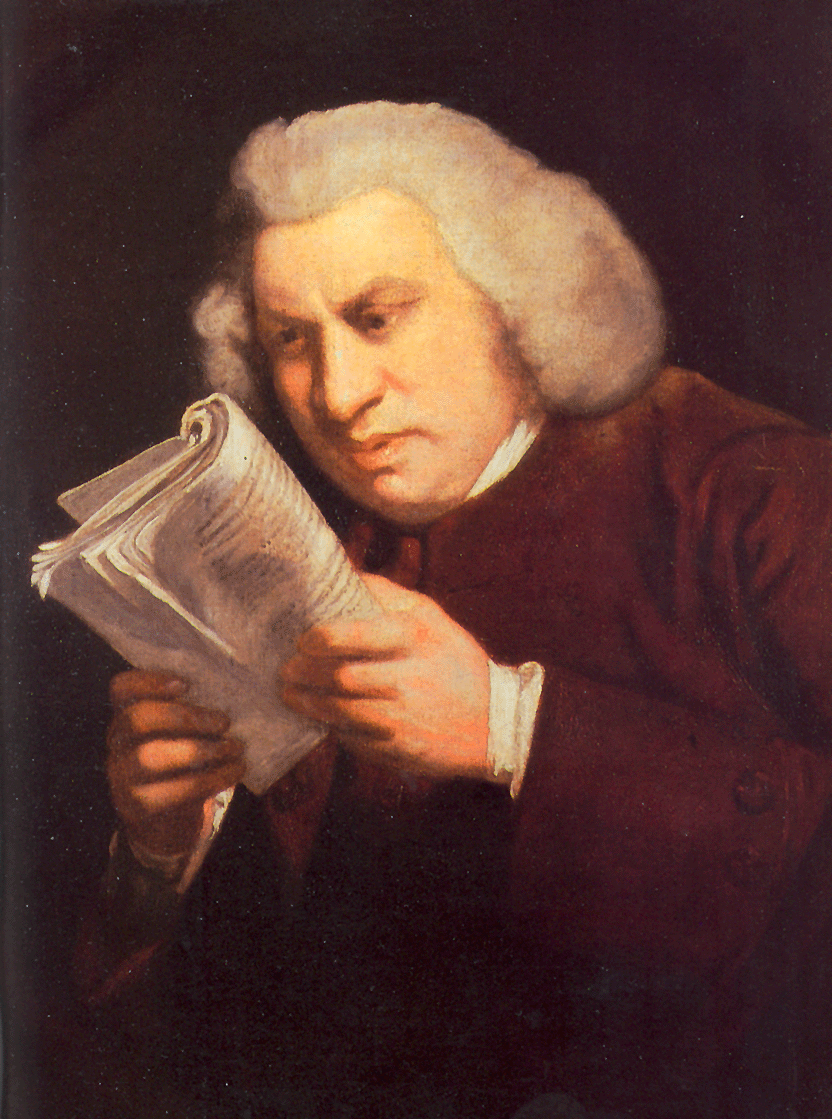
| Samuel Johnson (1709-1784) |
- P&P
- GUM: Samuel Johnson’s views of humanity were conservative and traditional. He criticizes the popular belief in progress the belief that things are getting better and better and the assumption that men and women are naturally good that is, the notion that if society is reformed, people will automatically do what is right.
- Finish presentations
- Copy down nails into notes.
- Please copy down the following Lit Terms and their definitions:
- Premise - an assertion that supports a conclusion
- Conclusion - the main assertion that follows from a premise or premises
- Counterargument - an opposing viewpoint or premise
- Refutation (to refute) - a discrediting of a counterargument
- Concession (to concede) - an acknowledgment of the merit of a counterargument
- Finish reading the following essays:
- Samuel Johnson's No. 5: "Proposal for a Female Army"
- Ryan Smith's "The Reality That Awaits Women in Combat"
- J12 - Logos, Ethos, and Pathos in the Service of the Military
- Identify Johnson's conclusion (his main assertion) and at least one premise that supports his conclusion.
- Identify at least one use of logos, ethos, and pathos (three total) in Johnson's article, explaining why each example qualifies as the particular type of appeal.
- Identify at least one use of logos, ethos, and pathos (three total) in Smith's article, explaining why each example qualifies as the particular type of appeal.
- Does Smith address any counterarguments to his position? If so, does he concede or refute any of them?
- What is the moral basis of Smith's whole argument (provide a quote that you believe sums it up)?
- Can you think of a counterargument to challenge his assumption?
- How would you describe the tone--the author's attitude--of each essay? (Select two adjectives to describe each one)?
- Of logos, ethos, or pathos, which one do you think appeals most to our culture at large today and why?
- Sonnet recitation
- Finish J12

No comments:
Post a Comment