Showing posts with label Renaissance. Show all posts

Monday, 1/8 - The Restoration (of the school year)

Shakespeare's prima donna
Welcome back, all ye courtiers! I know you're chomping at the bit to begin reading the historical background for the Restoration and the 18th Century, but before we get there, we need to back up just a bit to John Milton, the last great Renaissance poet and Puritan, and then back up once more to William Shakespeare, the greatest poet . . . all to do a comparison of Milton's "Satan" in his epic Paradise Lost and the villain Don John in Shakespeare's comedy Much Ado About Nothing. So that means we dig into super heavy text for the next couple of days and then begin a sweet cinematic version of Shakespeare's comedy. Hey, it must be a comedy if Keaneu Reeves is attempting Shakespeare! "Uh, yah, Trinity, I mean, Claudio."

So here's what we have for today's agenda:


  • Begin this segment from John Milton's Paradise Lost (lines 1-270) but read the following before beginning:

Your job over the next week or so is as follows: observe and record similarities between Satan and Keaneu, I mean, Don John in order to prepare for a THICE. Consider the villains' motives, words, thoughts, attitudes, actions, dwelling-places, victims, and arch-enemies. We don't think you'll find many physical similarities, but you just might surprise us.

HW: Finish copying down all nails and lit terms.

Block, 11/21, 22 - Sonnets and such

  • P&P 
  • Today we will spend some time looking at a very popular poetic form, the form you have all been demanding that I teach. I have heard your pleas and pleases, and after today I want to hear your "thank yous." Thus I give you a premature "you're welcome" to this blundering in the index to the book and volume of . . . the sonnet.  
  • Dig this sonnet flave for a bit: go to Focus and open the document entitled "The Sonnet" and read through the first two pages together. Now let's be sure you copy down and define the literary terms on the blog that you will need to know to study the sonnet. Define the terms below and discuss Shakespearean sonnet form using Sonnet 18 on the document you've opened.  
    • Sonnet (what is its etymology?)
    • Petrarchan (Italian)
    • Shakespearean (English)
    • quatrain
    • octave
    • couplet
    • volta (the "turn")
    • iambic pentameter 
  • Let's get back into Hamlet

HW: Go and give thanks for all God has showered upon you. Enjoy vacation! But for those who want to plan ahead, please see the following:
  1. Sight Words quiz 2 - right-hand column of handout on Focus (Quiz on the Tuesday we return from vacation)
  2. J9 (due Wed we return)

Monday, 11/18 - I will enter into his courts . . . wearing black

    Hamlet, anyone? Anyone, Hamlet? Hamlet. Hamlet. Omelet.
  • P&P
  • Sight Words Quiz 1 - When you finish, please begin J8 below.
  • "Hamlet . . . stands alone supreme in varied excellence. Ambition, murder, resistless fate, filial love, the love of woman, revenge, the power of conscience, paternal solicitude, infinite jest: what a volume is this!" - Henry Coppee (President of Lehigh University - 1873)

HW:  J8 - Hamlet, Act 1 (due Wednesday)

Read Leithart (pgs. 120-129) and answer the following questions (Remember that Leithart is the PDF posted on Focus that you used to do J6):
  1. What dramatic and thematic purposes does Fortinbras, the young prince of Norway, serve? 
  2. Contrast the late King Hamlet (the ghost) with Claudius (his brother and present King of Denmark).
  3. What is significant (and ironic) about fathers, particularly about most of the fathers in this drama?
  4. How does Shakespeare develop the theme that appearances sometimes mask reality (cite two examples)?
  5.  What is the purpose of Shakespeare's "ghosts"?
  6. Discuss the important question concerning the "nature" of the ghost (where it comes from) and how we know. 
  7. How was King Hamlet killed? What imagery does the ghost use to describe his death, and why is this (biblically) significant?  

Unit 4: The Renaissance


The Renaissance
  • Texts 
    • Brit Lit - Historical Eras (Google Classroom or "GC")
  • Nails
    • What was the Renaissance and how and why was it birthed?
    • Who were the major figures of the Renaissance (in Italy and England)
    • What were some of historical events that brought about England's golden age?
The Sonnet
  • Texts 
    • See "Handouts: The Sonnet" (Google Classroom)
    • Poetic Feet
  • Nails
    • What is classic Shakespearean (English) Sonnet structure and how does it differ from Petrarchan (Italian)?
  • Lit Terms 
    • Sonnet (what is its etymology?)
    • Petrarchan (Italian) Sonnet
    • Shakespearean (English) Sonnet
    • quatrain
    • octave
    • heroic couplet
    • volta (the "turn")
    • iambic pentameter 
Tragedy, Shakespeare, and Hamlet
  • Texts
  • Nails
    • How does Greek tragedy differ from Elizabethan (Shakespearean?)
    • Who are the principal characters in Hamlet, and what are their relationships with each other?
    • What makes a drama a tragedy and a protagonist a tragic hero?
    • How does Shakespeare use characters and scenes to mirror each other and develop particular themes?
    • How does Shakespeare use Biblical types and allusions to enlarge the meaning of Hamlet?


Monday, 11/11 - Intro to Tragedy and Hamlet

  • P&P
  • GUM
    • The term renaissance itself is a French word meaning rebirth it refers particularly to renewed interest in classical learning which means the writings of ancient Greece and Rome it's slogan was ad fontes which means back to the font.
  • Please go to Focus and get both new documents to help our foray into the realm of "The Bard": 
    • Hamlet - Leithart Journals 
    • Shakespearean High Frequency Archaic Sight Words (what a mouthful). 

Blinded by tragic vision
J7 - Intro to Tragedy and Hamlet

Read Leithart (document posted on Focus) pages 111-120 and answer the following questions:

Introduction: Tragedy (111-113)


1. According to the Greek philosopher Aristotle, what makes a drama a tragedy?

2. What kind of protagonist is generally required for a successful tragedy and why? 3. List several of the ways that Shakespearean tragedy differs from Sophoclean (or Greek) tragedy.
4. Given that the shape of Hamlet is a "Fall story," what types of characters, events, and ideas ought we to be looking for as we read?

Introduction: Hamlet (115-120)

5. Why is Hamlet such a popular drama?
6. What are two of the minor textual problems in Hamlet? What is one major problem?
7. Give two examples of the way Hamlet shows signs of compositional unity.
8. Cite two reasons why Leithart considers Hamlet a drama that condemns the revenge ethic.
9. Rather than viewing Hamlet as having "contradictions" and "loose ends," Leithart suggests that Shakespeare was making what profound observation?
10. How is Hamlet healthy reading for those who live in an age "dominated by scientific idolatry"? 

HW: 
  1. J7 (due block)
  2. Shakespearean Sight Words Quiz (next Mon) - be ready for the first half, the left-hand column. 

Block, 11/7 & 8 - Shakespeare & Co.

    Medieval torture device? Only for the uneducated ; )
  • P&P
  • GUM
    • Historical periods the Middle Ages the Renaissance the Romantic period are historians inventions useful labels for complex phenomena.
  • Today we  meet an author whom many high school students consider a secondary teacher's medieval torture device. Not so. Shakespeare is a Renaissance author . . . so there. 
  • Read, take notes on, and discuss "Intro to the Renaissance" (please see PDF on Focus entitled "Brit Lit - Historical Eras").
HW: Finish taking notes on "Intro to the Renaissance" and "The King James Bible" (Basically read through page 48 of the PDF that is on Focus).

Block, 12/13 - ICE, ICE, Baby!

*P&P

*Poetry Memorization

*ICE -  
  • You must plan for 3-5 minutes before you begin writing.
  • You must write for a minimum of 45 minutes.
  • You have a maximum time limit of 60 minutes.
  • When you're finished, please return the prompt sheet to the teacher, staple a rubric to the front of your essay, and turn the essay into the "Tests-Quizzes" tray. 

HW: 
  1. Tea Party (Mon)
  2. Begin reviewing for final 

Final Exam
  • Multiple Choice Exam  
    • Roughly twenty-five questions per category
      • Reading: Beowulf, Sir Gawain, Chaucer, Hamlet (and Leithart, the entire PDF on Focus)
      • Notes and Terms: From your binder (see esp. the left column of the blog)
      • History: Also notes in your binder (see the introductions to each literary period)
      • Grammar (more like 5-10 questions): MLA format
  • What will not be on the test?
    • Summer Reading
    • College Essay Writing
  • When do I take my test?
    • Per. 1 : Tue, 12/18
    • Per. 2-3: Wed., 12/19
    • Per. 4-5: Thu., 12/20
    • Per. 6-7: Fri., 12/21

Wednesday, 12/12 - Let's Kill this Drama

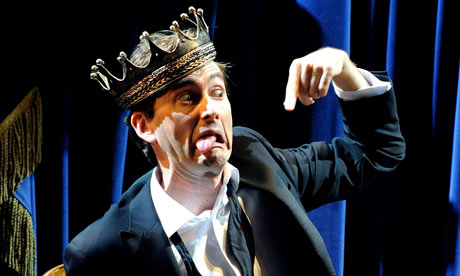
David Tennant as a rather loony Hamlet - Claudius is going down, baby!
*P&P

*Turn in Sonnet

*Finish vid

*Browse some sample essays (posted a couple of days ago)

*Read Leithart, pages 151-156 (PDF on Focus) to help clinch your critical knowledge of the drama, particularly the sections we skipped. It will help you prepare for the essay tomorrow.

*Submit sonnet to turnitin.com 

HW: 
  1. Binder Check (block)
  2. Poetry Memorization (block)
  3. ICE - Hamlet  (block) 
 

Tuesday, 12/11 - Hamlet Video Day

*P&P

*Finish Hamlet DVD and read the end of 5.2.

HW: 
  1. CWP - Sonnet (Wed)
  2. Poetry Recitation - Shakespeare's Sonnet 116     

Monday, 12/10 - I Aim Slain. Slain I Aim.

Dost thou likest green eggs and haim?
*P&P

*Correct Sight Words Quiz 2

*Power through Hamlet up through 4.3, then DVD, then read 5.2.355 to the end (this will probably last through tomorrow).

HW (revised due dates!!! Pay attention!)
  1. CWP - Sonnet (Wed). 
    1. If you're already finished and are ready to turn it in by Tuesday, you may receive an extra credit point. However, please don't rush to finish it to get the extra point. I don't want you to take two or more steps back to go one step forward. 
    2. Also, be sure to give me a printed out rubric so I can grade it. No rubric, minus one point ; )
  2. Sonnet 116 
    1. (Reno) Recitation (Block day)
    2. (Schwager) Writing (Block day)

Blauk, 12/6 - There's a Duel Meaning in That!

What is the Duel Meaning?
*P&P

*Turn in your J9 for a homework check.

*Sight Words Quiz 2 - When finished, please turn in and work on your CWP sonnet and/or Sonnet 116 to prepare for recitation early next week.

Some Reno sonnets:

Wifey Sonnet


The Holy Wind to Abyssinia bore
Us on the back of steel eagle’s wings
To land us in the orphan’s desert for
A royal orphan son from Judah’s King.
This fertile continent--heavy with child--
Bore for us our beloved Beniam boy.
Oh, Africa--womb of our son’s womb--wild
The Land where Spirit hovered for our joy.
The angel bard once likened childed womb
To sails big-bellied blown by wanton wind.
Your grace-filled fabric taut, a watery room,
Now harbors holy gift, a sacrament.
As Africa once bulged with right hand seed,
Inspired your belly is with ‘Vangeline. 


One to his seniors several years ago

When I consider sonnets I turn green.
I gag. I heave. Dry heaves, they will not stop
Until I write a quatrain . . . wait! I mean
An octave! (What I've written is mere slop.)
I cannot do this . . . meter? When will't end?!!!
As soon as meter's dial'd I kill the rhyme.
This casualty results when I don't tend
All sheep at once. I'm running out of time . . .
Shakespear'ean hydra! Come at me full force!
My loins I'll gird and stand my ground a man
Who will not shirk from war, nor from the course
will I depart. (my mind has hatched a plan!)
Submission to this yoke (the sonnet's weight)
Now means I've earned the right to graduate. 
 
*Any questions on J9?

*Hamlet . . . up through 4.3 then DVD, then 5.2.355 to the end.

HW: 
  1. CWP (Tues) - remember to do an artistic component to beautify your already beautified Ophelia ("Beautified's a vile phrase") . . . I mean, sonnet.
  2. Poetry recitation (Tues)

Wednesday, 12/5 - Schwager is kewl ; )

*P&P

*Sight Words to consider through examples:

  •  Thou (you - informal): When "you" is the subject of the clause
    • C (correct): Thou wilt (You will) give me a tweak
    • I (incorrect): I will give thou a tweak 
  • Thee (you - informal): Use when "you" is the object of the clause
    • C: I will give thee a tweak on the nose. 
    • I: Thee will give me a tweak. 
    • Thy (your): possessive, often used before a word that begins with a consonant sound. Keep the "a/an" article rule in mind: "a" cat, not "an" cat. Thus, "thy horse."
    • Thine (your): possessive, often used before a word that begins with a vowel sound. Keep the "a/an" article rule in mind: "an" owl, not "a" owl. Thus, "thine" owl.
    • Ye (your): plural form of "you" when addressing a group of people
    • You (you - formal) 

    *Hamlet

    HW: 
    1. Sight words quiz
    2. J9
    3. CWP Sonnet (Tues)